
IFC Drawings vs Shop Drawings: What Changes Between the Two Sets
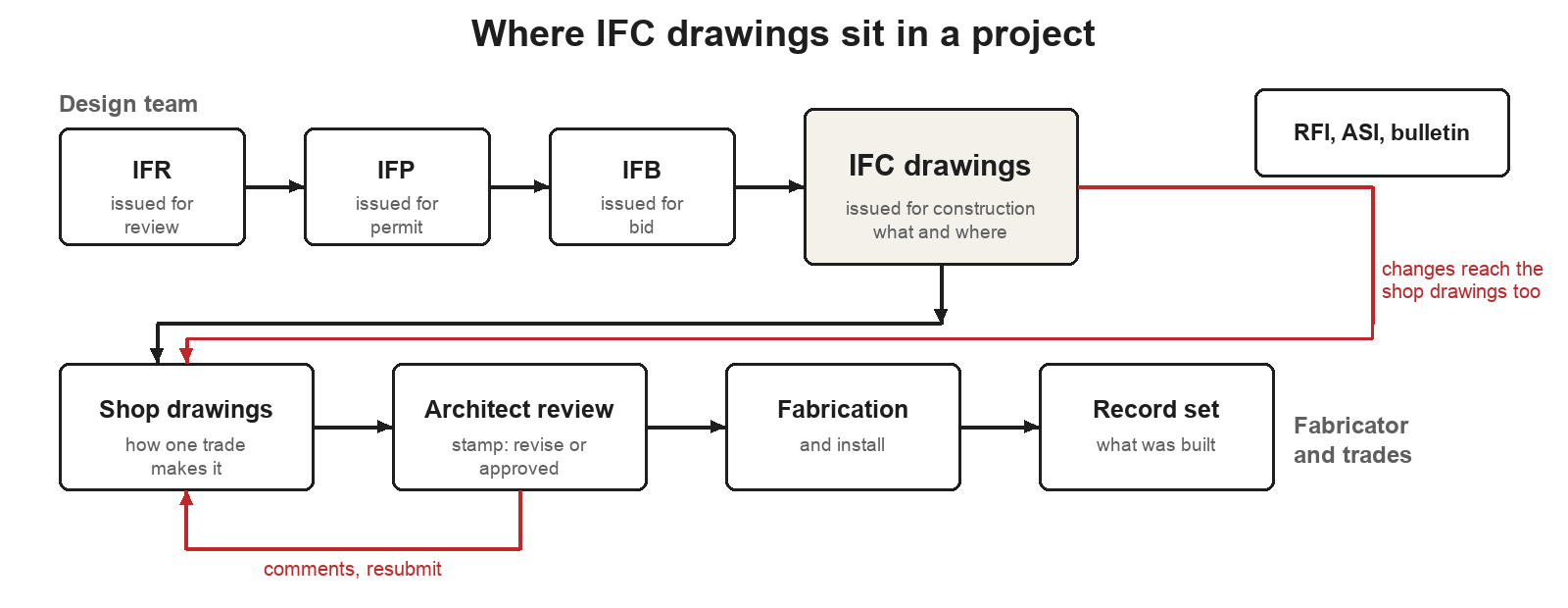
Where IFC sits in a project. Shop drawings start after it and loop through review until approved.
IFC drawings are the set the design team releases as “Issued for Construction”. It’s the version the contractor is meant to build from, and the version every shop drawing on the job has to answer to.
We draw shop drawings from these sets every week, and we’ve learned that the stamp on the sheet says less than people think. An IFC set can still have holes. So here’s what the label means, how the set differs from shop drawings, and what happens to it once the job starts moving.
Contents:
- What IFC means in construction
- Where IFC sits among the other issues
- IFC drawings vs shop drawings
- How a shop drawing gets built from an IFC set
- When the IFC set changes: RFIs, ASIs and bulletins
- What IFC sets usually leave open
- IFC drawings FAQ
What IFC means in construction
IFC stands for Issued for Construction. Somebody on the design team has decided the drawings are coordinated enough to build from, puts that status on every sheet, and sends them out. You’ll also see AFC, approved for construction, or simply CD set with a date on it. On plenty of US commercial jobs nobody uses the letters at all, and the “for construction” set is just the latest issue of the construction documents.
One thing to clear up, because Google mixes them too. In the BIM world IFC also means Industry Foundation Classes, an open file format for sharing models. If a contractor asks for “the IFC drawings” they want the sheets. If a BIM manager asks for “the IFC”, they probably want a file.
Where IFC sits among the other issues
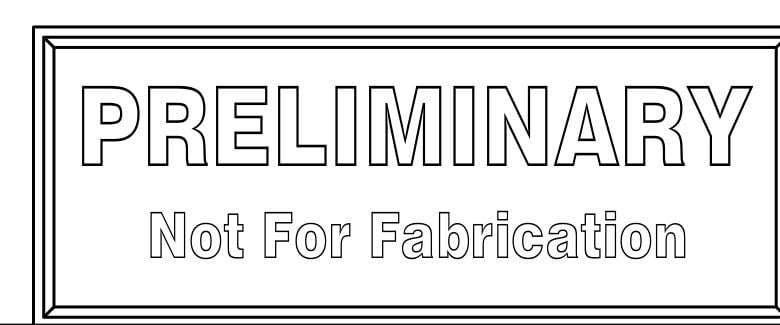
Status matters on both sides. This shop sheet is stamped preliminary, so nobody builds from it yet.
A set goes through several releases before anyone cuts anything. Labels change from one office to the next, but the order is pretty stable.
| Issue | Means | Can you build from it? |
|---|---|---|
| IFR | Issued for review, owner and team comments | No |
| IFP | Issued for permit, goes to the building department | No, it may be missing fabrication and trade detail |
| IFB / IFT | Issued for bid or tender, contractors price from it | No |
| Conformed set | Bid set with addenda folded in | Only if it is also issued for construction |
| IFC / AFC | Issued or approved for construction | Yes, along with approved shop drawings |
| Record set | What was built, after the job | No, it is for the owner and future work |
Common issue labels. Your project may use different letters for the same stages.
The word that matters is status. A drawing marked for bid or for permit might look complete, and it’s tempting to start building from it. Don’t. Check the status on the title block and the date on the index before you trust a dimension.
IFC drawings vs shop drawings
Think of it as what against how. The IFC set says what the designer wants and where it goes. Shop drawings say how one trade will actually make it, down to the screw. They come from different people, at different times, for different readers.
| IFC drawings | Shop drawings | |
|---|---|---|
| Who draws them | Architect, designer, engineers | Fabricator, subcontractor or their drafter |
| What they answer | What goes where and how it should look | How this trade will make and install it |
| Level of detail | Design intent, typical conditions | Every part, joint, material and fastener |
| Dimensions | Often to be verified on site | Coordinated to field conditions where possible |
| Who approves | Issued by the design team | Reviewed by architect, sometimes the GC first |
| Contract document? | Yes | Usually not |
The same piece of work, from two sides.
There’s a legal difference too, and it catches people out. Under the standard AIA general conditions, shop drawings aren’t contract documents. The IFC set is. So when a shop drawing and the architect’s sheet disagree and nobody asked about it, an approval stamp won’t necessarily save you. Your own contract decides this, so read it, but that’s the usual starting point.
If you want the longer version of what a shop set contains, we’ve covered it in our guide to shop drawings and in the comparison of shop and fabrication drawings.
How a shop drawing gets built from an IFC set
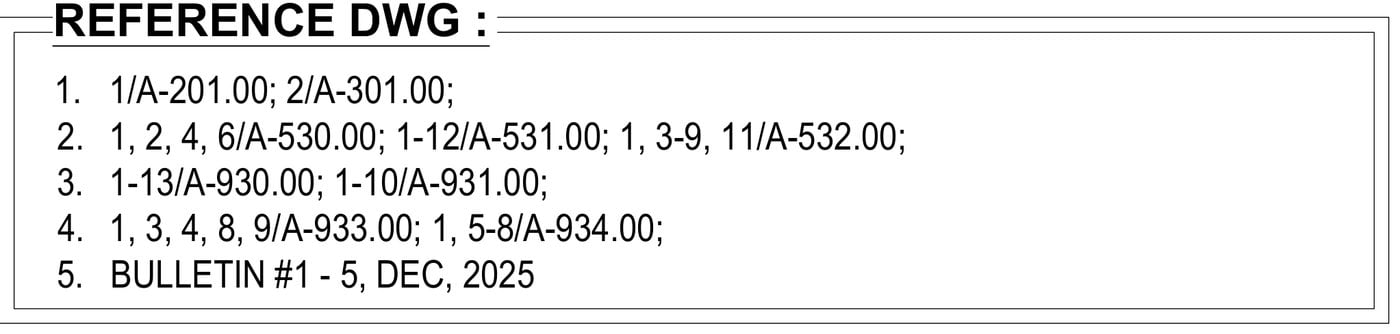
The reference list on one of our paneling sheets. Architect sheet numbers, then the bulletin issued while we were drawing.
Our first move on any job is to write down exactly which sheets we’re working from. Those few lines are from a real wall paneling package. They list the architect’s sheets by number, and at the bottom a bulletin that came out while we were drawing. If a question comes up two months later, nobody has to guess which version we were looking at.
Then we redraw the piece of work at shop scale. A cabinet that’s a rectangle on the architect’s elevation becomes a box with a stated material, a door gap, a hinge and a way of being fixed to the wall. Along the way we hit things the IFC set doesn’t answer, and each one goes out as a question. Is that dimension to the stud or to the finish? Who’s providing the blocking? Which of these two door swings is right?
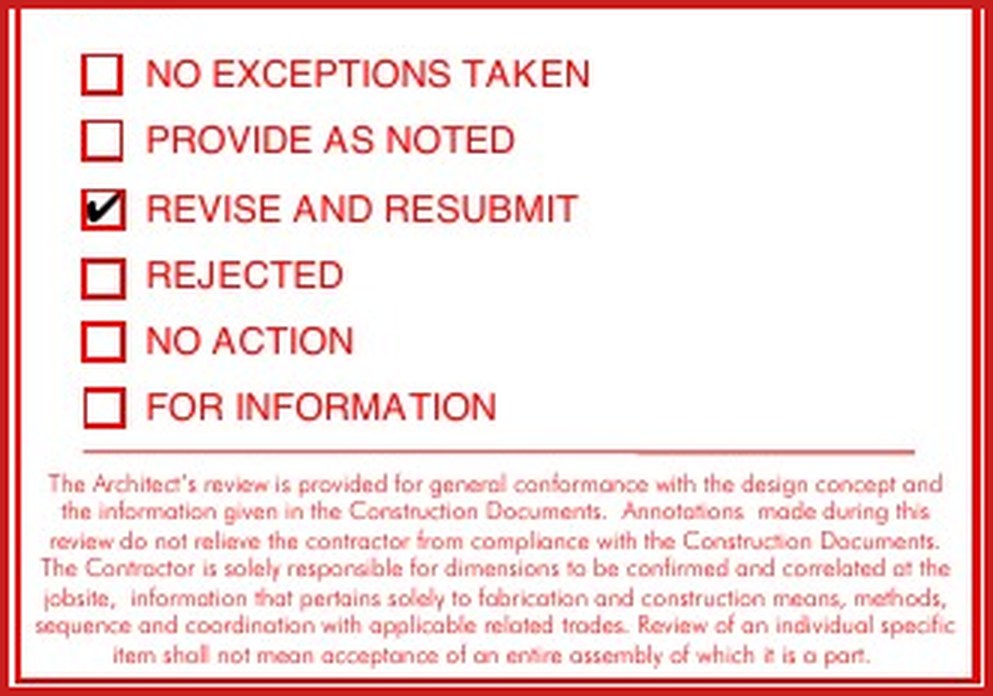
A real review stamp, with the name removed. Revise and resubmit means no fabrication yet.
After that the set goes in as a shop drawing submittal and comes back stamped by the architect. Look at the small print on that stamp. Review is “for general conformance with the design concept”, and the contractor stays responsible for dimensions. Nobody fabricates until it says something other than revise and resubmit.
When the IFC set changes: RFIs, ASIs and bulletins
IFC doesn’t mean frozen. Most jobs change while they’re being built, and the changes arrive under a few different names.
An RFI, a request for information, is a question from the field to the design team, and the answer can quietly change what gets built. An ASI, architect’s supplemental instructions, is a small change or clarification with no cost or time attached. A bulletin is a package of revised sheets, usually with a pricing request behind it. And a change order is the signed deal on money and schedule.
The trap for a shop is timing. Say we’re on sheet 12 of a reception desk and Bulletin 3 moves a wall by four inches. If nobody forwards it, the desk gets built to the old wall. That’s why we ask every client the same thing before each resubmittal: has anything come out since we last spoke? On the shop’s side, the revision list on the title block should say what changed and why.
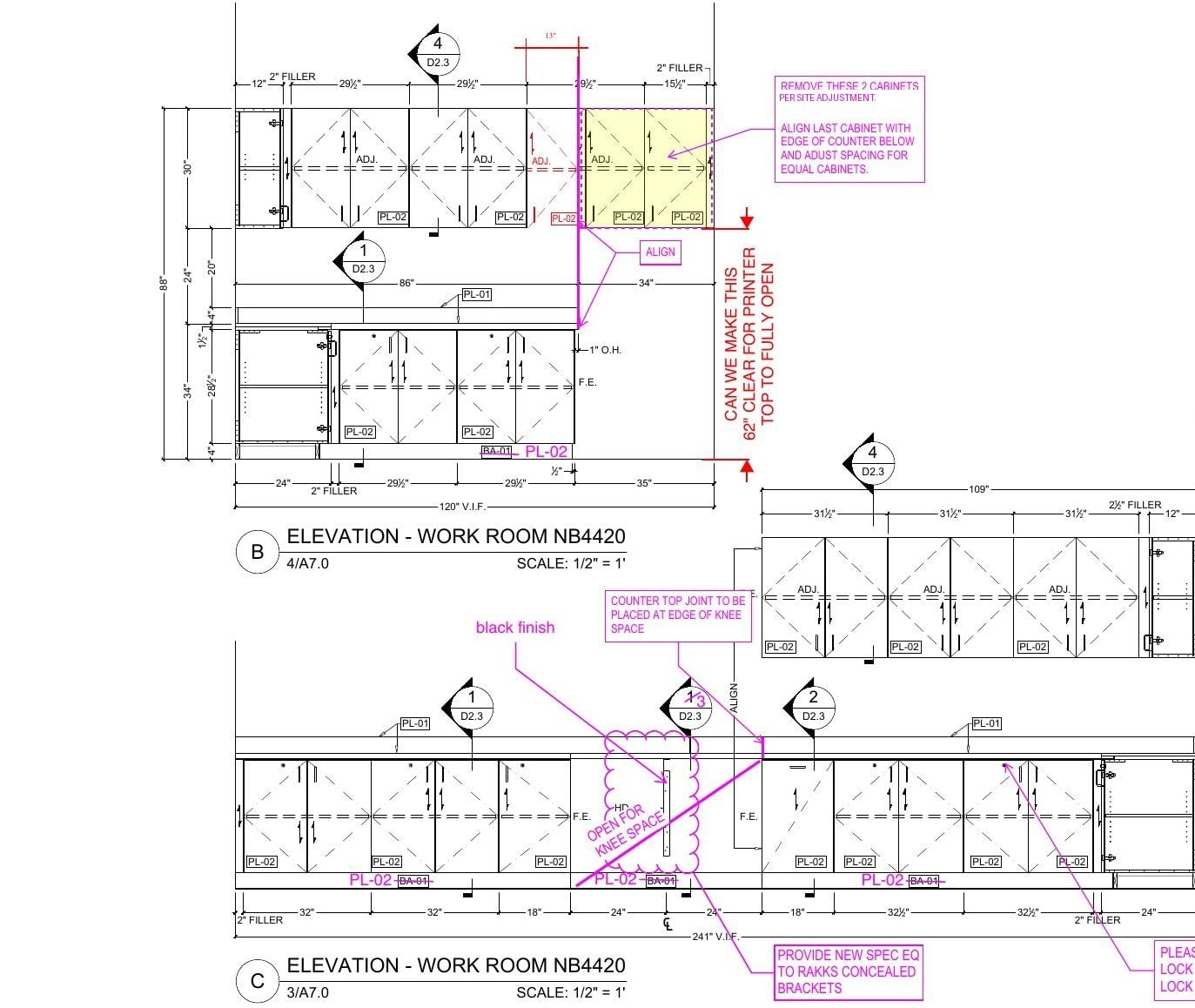
Comments on a shop set in review. Each one gets answered or drawn in before the next round.
What IFC sets usually leave open
Honest IFC sets still have gaps, and on purpose. Millwork is a good example. The architect draws the look and leaves the construction to the fabricator, with a note along the lines of “see shop drawings”. Hardware is often a spec reference. Blocking is sometimes nobody’s. Field conditions can’t be known until the walls are up, so you get VIF next to half the dimensions.
Other gaps aren’t on purpose. A door tag with no row in the schedule. A detail bubble pointing to a sheet that isn’t in the set. Two sheets that show the same wall at different lengths. We keep a running list and send it before drawing too far, because a question asked in week one is free, and the same question asked after fabrication isn’t.
If you’re holding an IFC set and need the millwork drawn from it, that’s what we do. Our millwork shop drawing services page has the process and the rates.
IFC drawings FAQ
What does IFC mean in construction?
Issued for Construction. It’s the label on the set the design team says you can build from. On some jobs you’ll see AFC instead, or just a dated CD set. And if a BIM person says IFC they may mean the open model file format, which is another thing altogether, so it’s worth asking.
What is the difference between IFC drawings and shop drawings?
Who drew them and what for. The architect’s IFC sheets tell you what’s wanted and where. Then a fabricator, or a drafter like us, works out how it actually gets made and draws that, parts and joints included. The first set is a contract document. The second usually isn’t.
Can you build from IFC drawings without shop drawings?
For a lot of field work, yes. Framing crews build from the architect’s and engineer’s sheets every day. Anything made in a shop is different. Cabinets, stairs, steel and curtain wall normally need approved shop drawings first, and the spec will say which items.
What is the difference between IFC and permit drawings?
A permit set is aimed at the building department, so it’s there to prove code compliance. Trades need more than that. Hand a permit set to a fabricator and the first week is all questions about things it was never meant to answer.
Why is it called a shop drawing?
Because it’s drawn for the shop, the place where the thing gets made. Millwork shops, steel shops, sheet metal shops. The name goes back to when the fabricator’s own draftsman sat at a board out back, and it stuck even now that most of them are done in CAD, often by outside drafters.
What happens if IFC drawings change after shop drawings are approved?
Somebody has to catch it. A bulletin or an ASI should reach the fabricator, the shop drawings get revised and clouded, and if it costs money there’s a change order. The bad version is when the update stops at the GC’s inbox and the shop builds to the old sheet.
Wonder how much high-quality drafting services cost? Check out the examples of our real projects with pricing.

Nathalie Paul
Blog Writer
Nathalie is a senior draftswoman at ArchiCGI. She loves the fine art of creating quality drawings. After work, Nathalie is passionate about Ishvara yoga, traveling, and strong bitter coffee.
