
Wood Veneer in Millwork: Cuts, Matching and How It’s Drawn
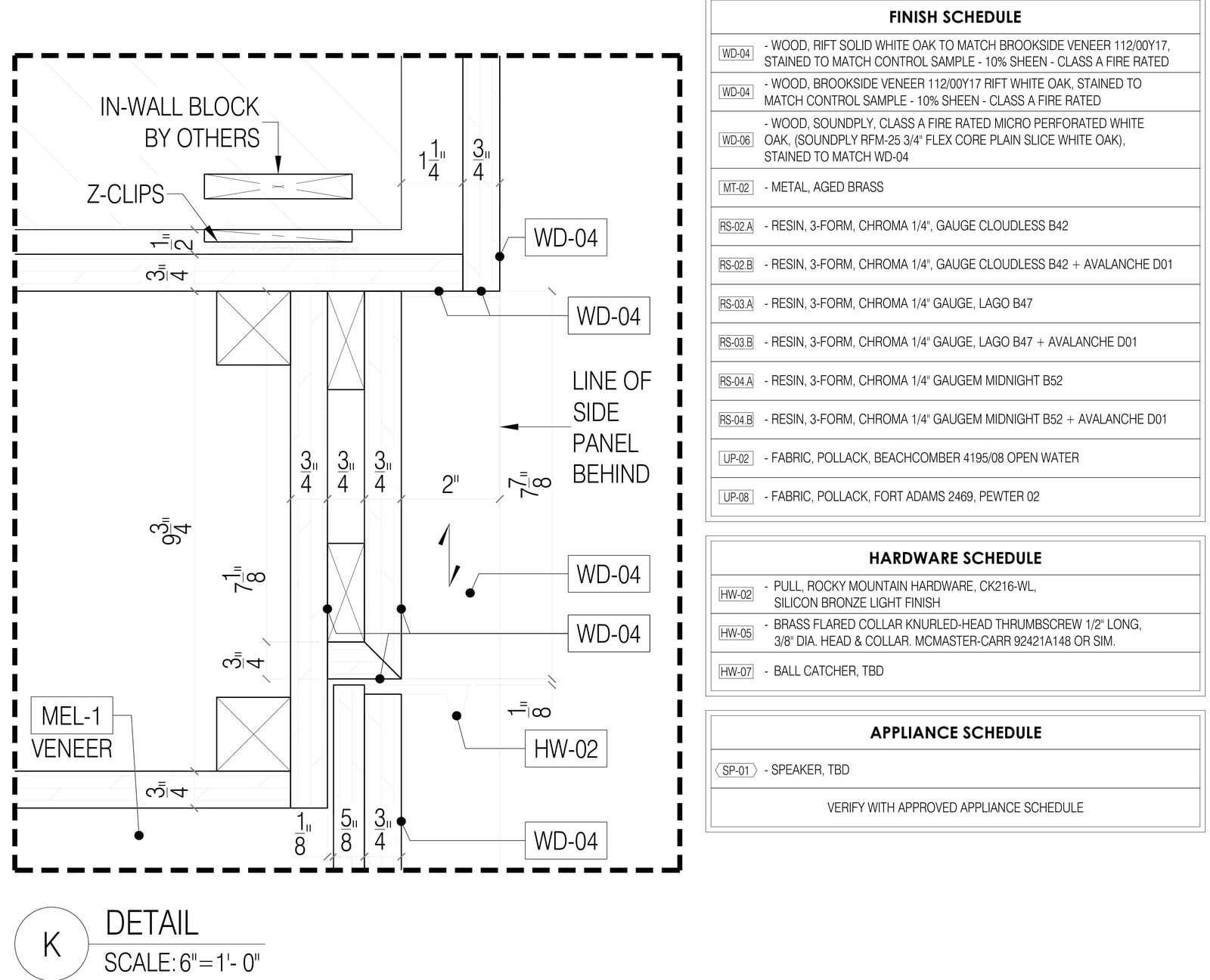
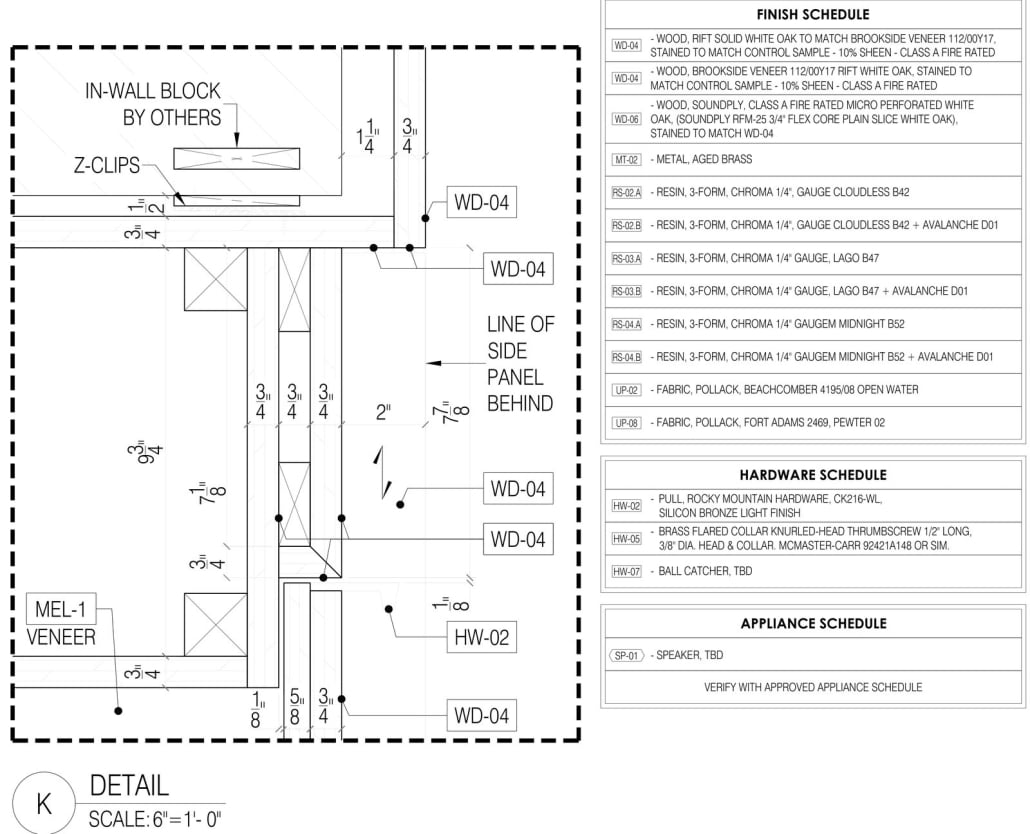
One detail from a veneered wall package. Every WD-04 tag on the section points back to two lines in the finish schedule on the right.
Open any commercial millwork set and you’ll find a tag like WD-04 sitting on half the elevations. On a synagogue fit-out we drew last winter, WD-04 was rift white oak veneer, stained to a control sample, 10% sheen, Class A. Six facts hiding in five characters. Lose one of them on the way to the shop and somebody either guesses or writes an RFI. Guessing is worse.
So this is veneer seen from the drafting table. We’ll go through the cuts and the matches, because they change a wall more than people expect, and then through what we actually write on the sheets so the panel that arrives on site is the one the designer chose.
Contents:
- What wood veneer is
- How veneer is cut from the log
- Matching leaves: book, slip and the rest
- Matching across a panel and across a room
- How veneer shows up on shop drawings
- Veneer vs laminate vs solid wood
- What we ask before we draw a veneer job
- Wood veneer FAQ
What wood veneer is
Veneer is real wood, sliced very thin and glued to something that doesn’t move. How thin? On architectural panels the face is usually about 1/42 of an inch. Hold a leaf up to a window and you can see light through it. The core underneath is MDF, particleboard or veneer core plywood, and on fire rated work it’s a rated MDF or particleboard. So yes, veneer is real wood. It’s just not solid wood all the way through.
People sometimes hear “veneer” and think of the plastic wood grain on cheap furniture. That’s laminate or a printed foil, a photo of wood on paper or plastic. A veneer leaf comes off an actual log, and two leaves from the same log are never quite alike. That’s the reason designers pick it, and the reason it needs more care on the drawings than a laminate does.
Why not solid wood on a 10 foot wall? Try it once. Boards that wide swell in August, shrink in January and cup somewhere in between. Put the same oak on an MDF core and it stays flat, it’s cheaper, and you can run one figure across the whole room. On a big project the panels for one wall often come from a single log, cut in order. You can’t get that out of a lumber yard.
How veneer is cut from the log
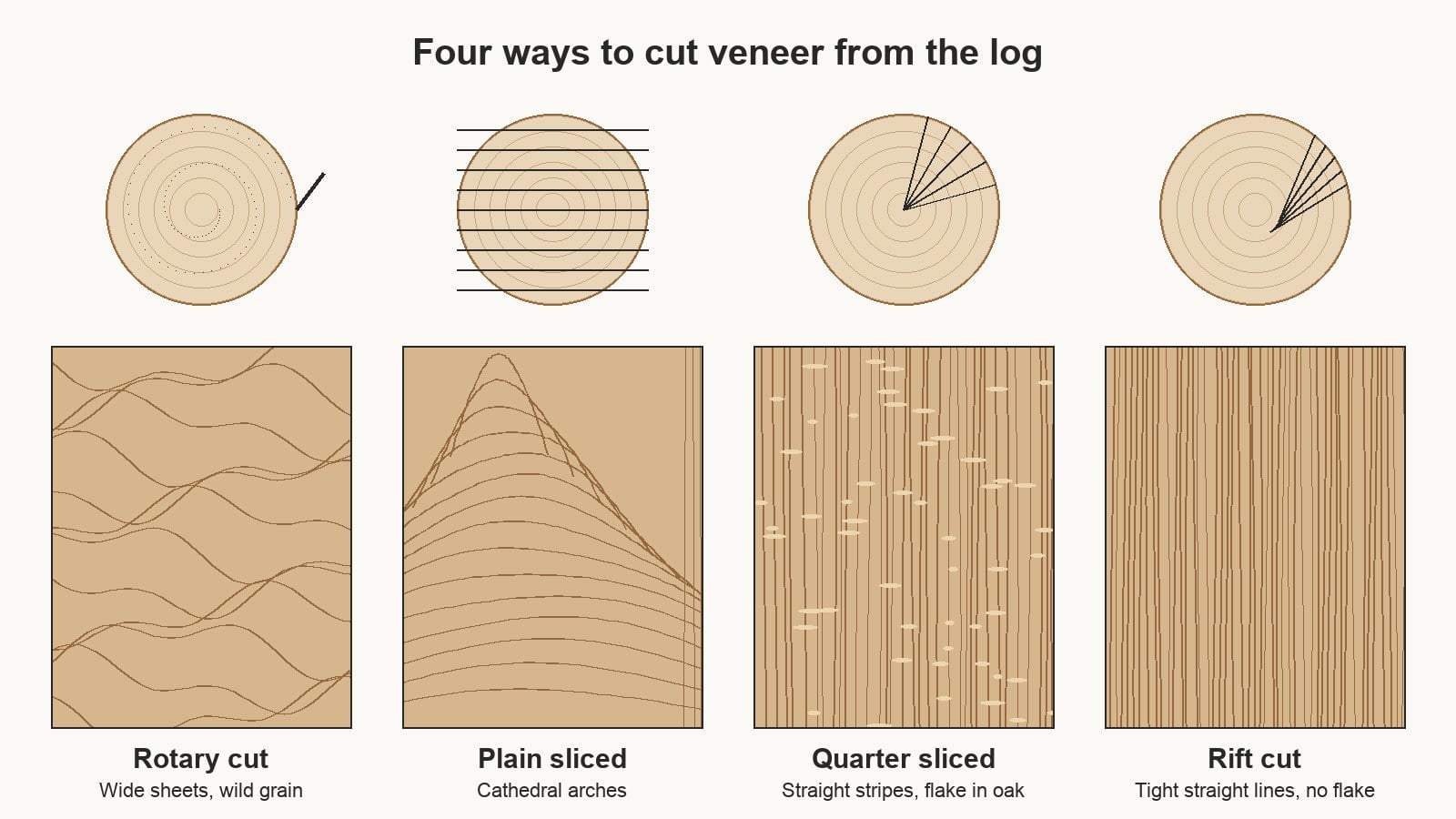
Same log, four cuts. The end view shows where the blade goes, the panel below shows what you get on the wall.
Mills slice a log, or a chunk of one they call a flitch, in four main ways. Same tree, four very different walls.
Rotary cut. The log turns against a blade, the way you’d unroll paper towels. You get wide, cheap sheets with a loud, wavy grain. It’s what goes on most plywood. In architectural work you mostly see it on birch and maple, often where nobody looks closely.
Plain sliced, also called flat cut. A half log is sliced parallel to its center. This gives the cathedral pattern most people picture when they think of wood, arches in the middle and straighter grain at the edges. It’s the default for a lot of walnut, cherry and oak work.
Quarter sliced. The blade runs roughly at right angles to the growth rings, so the grain comes out as straight stripes. In oak you also get flake, the shiny ray marks that cross the stripes. Some designers love it. Others write “no flake” in the spec.
Rift cut. Mostly oak. The slice is taken a little off the quarter so the flake almost disappears and you’re left with tight, straight lines. That’s the rift white oak you see in so many offices and lobbies right now, and it costs more than plain sliced oak because there’s more waste.
For the drawings the takeaway is short. “Oak veneer” isn’t a spec. “Rift white oak” is one, and so is “plain sliced red oak”. A quarter sliced oak and a rift cut oak sitting next to each other look like different woods.
Matching leaves: book, slip and the rest
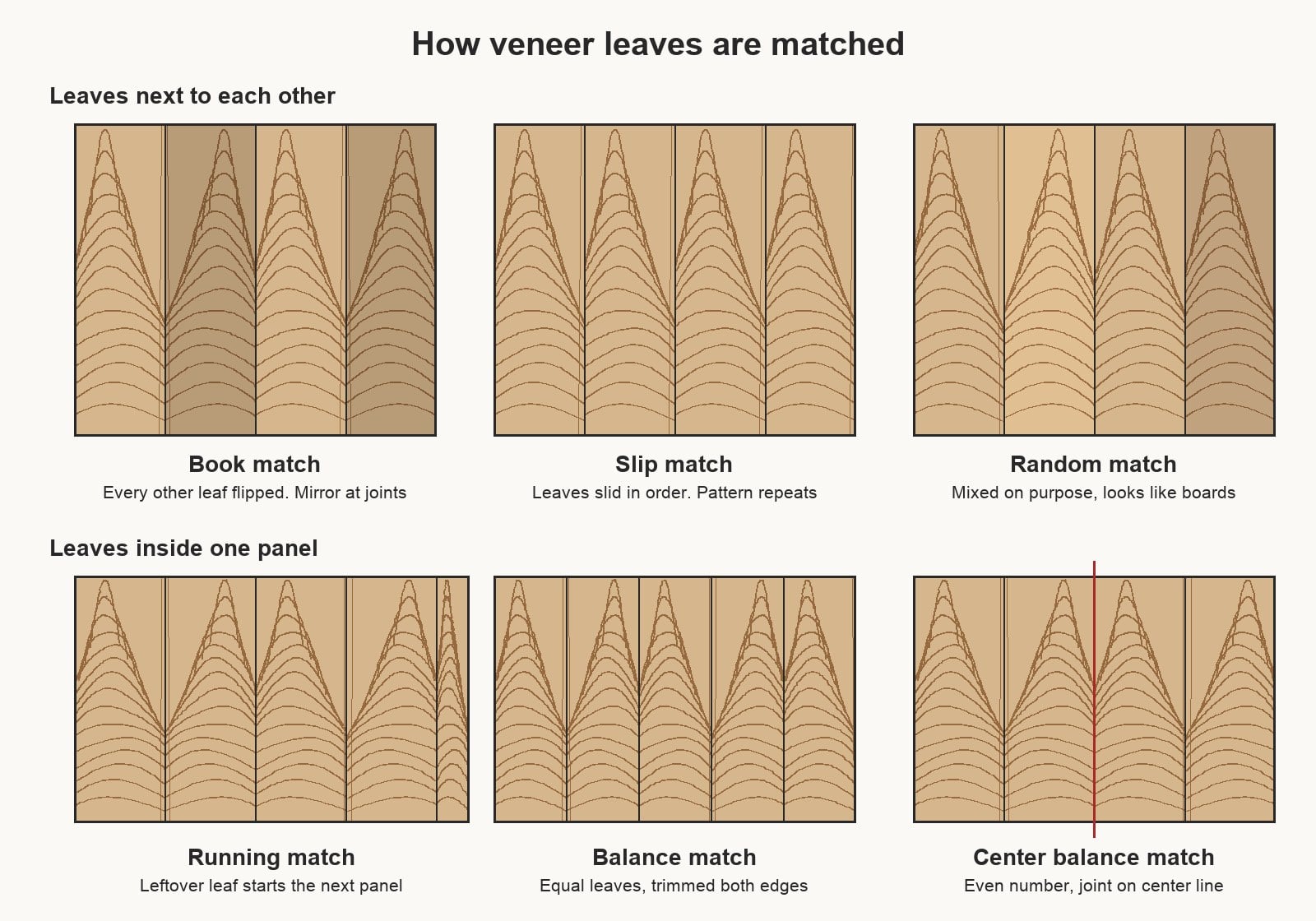
Top row: how neighbouring leaves are laid. Bottom row: how the leaves are sized inside one panel. The red line marks the center joint.
Leaves are narrow, often under a foot wide, so one panel face takes several of them side by side. The way they sit next to each other is called the match. In our experience it’s the line most often missing from a spec.
Book match: flip every second leaf over, the way you turn a page. Now the grain mirrors at each joint, so you get those symmetrical patterns you see on high end walnut walls. One thing people don’t expect: because every second leaf shows its other face, it catches light a bit differently. Under a stain the panel can look striped light and dark. Shops call it the barber pole effect. It’s normal for book matching, and the designer should know about it before the panels get finished, not after.
Slip match skips the flipping. Leaves just slide along in the order they came off the flitch, so the figure repeats instead of mirroring and the color holds steadier. You’ll see it a lot with rift and quarter sliced stock, since straight grain repeating doesn’t look odd.
Random match (some shops say mismatch) shuffles leaves on purpose, and plank match goes further with mixed widths, sometimes from other flitches, so the wall reads like boards. Cheaper, forgiving, casual. Fine if that’s the look you want. Not fine if it just happened because nobody wrote a match down.
Matching across a panel and across a room
Then comes the panel itself. Three options, and from across a lobby you can tell them apart.
Running match is the thrifty one. Leaves go on from one edge until the panel is full, the last leaf gets cut wherever it lands, and its leftover starts the next panel. Little waste, but you end up with skinny strips at the edges. A balance match uses leaves of equal width in each panel, trimmed so both edges match. A center balance match goes one step further: an even number of equal leaves with a joint running right down the middle. That’s the one you want on a pair of doors or on a feature wall that’s symmetrical around a center line.
Then there’s the whole room. Pre-manufactured sets are stock panels from one flitch, put up in whatever order they arrive. Sequence matched panels are all the same size and get installed in the order they were made, so the grain flows from one panel to the next. Blueprint matching is the top level. Every panel is sized to the actual wall, doors and transoms included, and laid out on the drawings before any veneer gets cut. It looks the best and costs the most, and it means the shop drawings have to show every panel with its size and number.
On a blueprint matched wall the elevation is the real product. If an outlet moves or a door grows two inches after the layout is approved, panels get recut, and some of that log is gone for good.
How veneer shows up on shop drawings
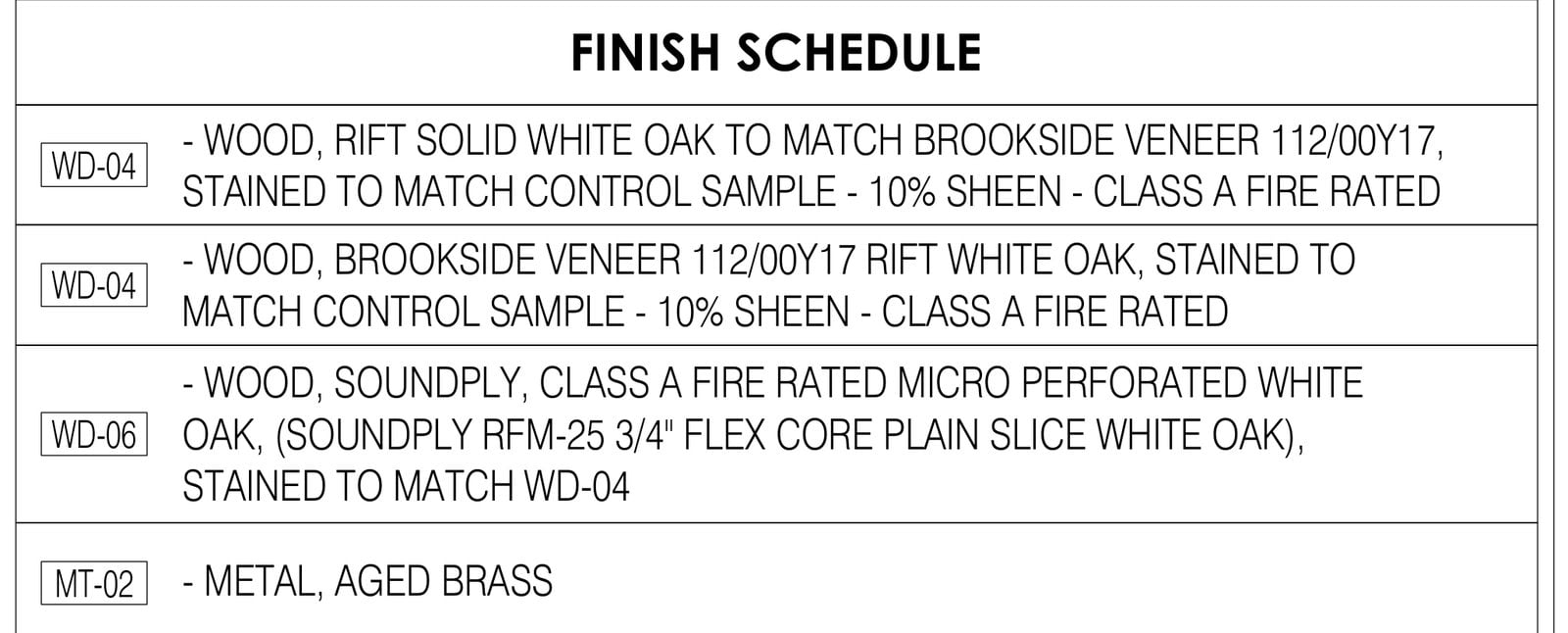
Three lines from the finish schedule. Species, cut, supplier code, stain, sheen and fire rating, all in one place.
On the sheets veneer appears in three places. The finish tag on plans, elevations and sections, the finish schedule that explains each tag, and the details that show cores, edges and joints.
The finish schedule line is where most of the information lives. Here’s what we try to have in it on every veneer job: species and cut, the match, the core material, the backer, the finish and sheen, the fire rating if there is one, and the supplier or control sample the shop matches to. Look at the two WD-04 rows above. The second one is the veneer itself, a rift white oak with a supplier number, stained to a control sample, 10% sheen, Class A. The first one is solid rift oak for edges and trim, written to match that veneer. Solid and veneer always age a little differently, so saying out loud which one follows which saves an argument later. WD-06 is a different product again, a micro perforated white oak on a 3/4 inch flex core, and its line says plainly that it gets stained to match WD-04.
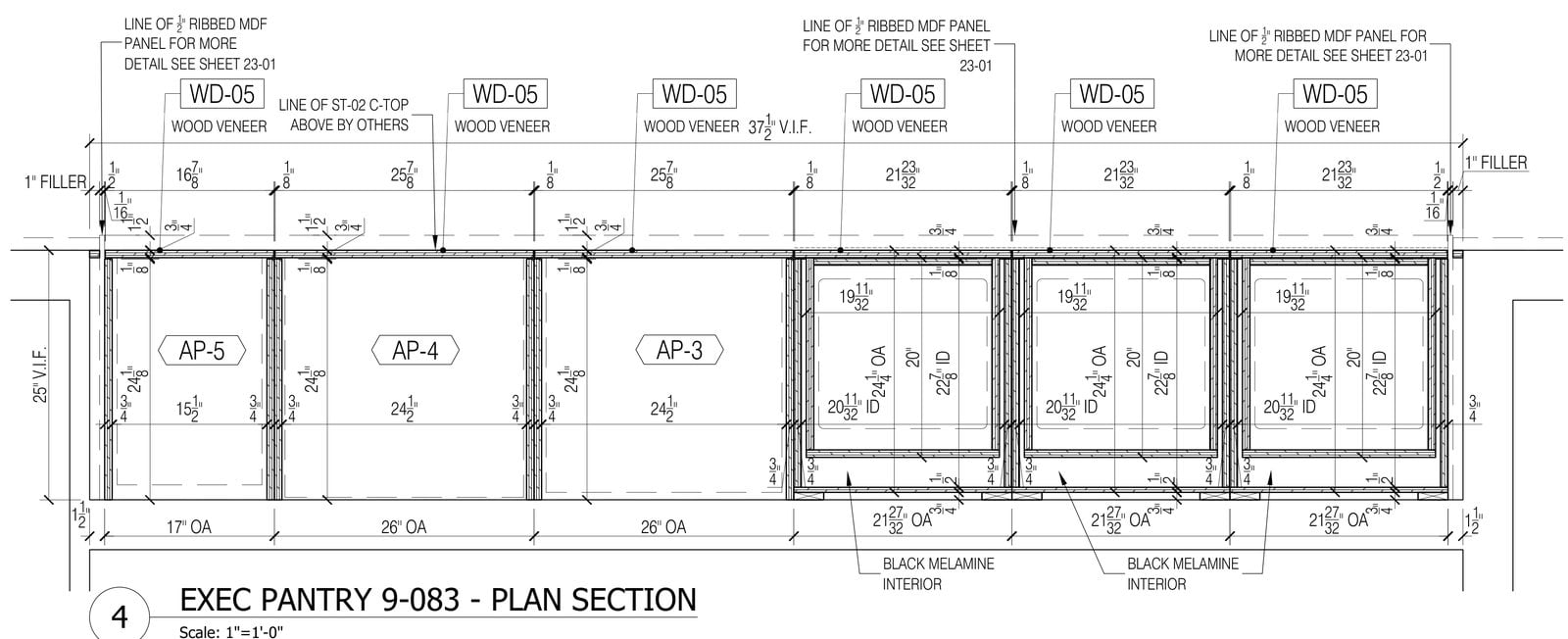
Exec pantry, plan section. Veneer on everything you can see, black melamine inside the boxes.
Plan sections show where veneer stops. On the pantry above, every exposed face is wood veneer and the cabinet interiors are black melamine. That’s normal on commercial work, and it saves real money, but it has to be drawn. If the plan section just says “veneer” and nothing about interiors, the shop will price whatever they think is meant.
A few more things belong on the sheets. Grain direction, usually an arrow on the elevation, because a vertical grain wall and a horizontal grain wall are two different products. Panel joints and reveals, so the leaf layout and the panel layout don’t fight each other. Edge treatment, for example a note that edges are banded to match the face unless noted otherwise. And the backer. A veneer on one face and nothing on the other will pull the panel into a curve, so the back gets a balancing veneer or laminate. You’ll see it as a short note in the section, and it does more than it looks like.
Where the spec and the architect’s drawings don’t agree on veneer, we write it down as a question on the submittal instead of picking one. Our millwork shop drawing examples show how those notes and tags look on real sheets.
Veneer vs laminate vs solid wood
Clients ask this a lot, usually in the form “why not just use laminate”. Here’s how the three compare on a typical millwork job.
| Wood veneer | Laminate | Solid wood | |
|---|---|---|---|
| What it is | A thin leaf of real wood on an MDF, particleboard or plywood core | Printed paper and resin pressed onto a core (HPL) or melamine | Wood all the way through |
| Where it goes | Wall panels, casework faces, reception desks, doors | Counters, cabinet interiors, hard working tops | Edges, nosings, trim, hand rails |
| Looks | Every leaf a little different, figure can be matched across a room | Same print repeats, very even | Board by board, wide surfaces show joints |
| Wear and repair | Takes light sanding and refinishing, deep damage is hard to patch | Very tough, but a chip can only be patched or replaced | Can be sanded and refinished many times |
| Moves with humidity | Barely, the core keeps it flat | No | Yes, needs room to move |
| Cost, relative | Middle, goes up fast with blueprint matching | Lowest | Highest for big flat areas |
| What the drawings must say | Species, cut, match, core, backer, finish, fire rating | Maker, pattern number, finish, edge | Species, grade, moisture, profile |
Most real projects mix them. Veneer on the faces people see, laminate or melamine inside the boxes and on hard working tops, and solid wood where an edge or a nosing takes a beating. The drawings just have to say which one goes where.
What we ask before we draw a veneer job
When a veneer job comes in, the first email from our side usually has the same short list of questions. Which species and cut? Book or slip match, and running, balance or center balance inside the panel? Is it sequence matched or blueprint matched across the room, or are stock panels fine? What core, and does it need a fire rating? Which way does the grain run? How are the edges finished? Is there a control sample, and who signs it off?
About half the time the answers are already in the spec section and just didn’t make it onto the architect’s sheets. The other half, the designer hasn’t decided yet, and it’s a lot cheaper to decide now than after the flitch has been bought. Either way the answers go onto the drawings, so the shop, the installer and whoever reviews the submittal are all looking at the same thing.
If you’re putting together a veneer package and want it drawn to your title block and your standards, our millwork shop drawing services page explains how we work and what it costs. For cabinet work in particular, see our guide to cabinet shop drawings, and for where veneer sits in the spec book, the article on the millwork CSI division.
Wood veneer FAQ
Is veneered wood real wood?
It is. Every leaf comes off an actual tree, and if you sanded through the finish you’d find oak or walnut, not paper. The confusion comes from laminate and foil, which are pictures of wood.
What are the downsides of wood veneer?
Mostly that it’s thin. A wet glass left on an edge for a weekend, or a chair banged into a panel, can go through to the core, and you only get so many sandings. Matching is the other one. Two panels from different flitches can look like cousins rather than twins, and fixing that properly costs money. Good edges and a backer on the drawings prevent most of the trouble.
Are wood veneers expensive?
Compared to solid wood over the same area, no. Compared to laminate, yes. Species and cut move the price, and rift white oak sits well above plain sliced red oak. What really changes the number is matching. Stock panels are cheap, sequence matched sets cost more, and blueprint matching a whole room is where budgets get nervous.
What does bookmatched wood mean?
It’s the look you get when a pair of leaves gets opened up like a book, so the left one is a mirror of the right. Think of those walnut lobby walls with a pattern that looks a bit like a Rorschach test. After staining there’s often a soft stripe, lighter then darker, leaf after leaf. Shops call that barber poling. Nothing went wrong, it’s just how light hits the two faces of the wood.
How can I tell if cabinets are laminate or veneer?
Honestly, the easiest test is to find a knot or a dark streak and look for it on the next door. Real veneer won’t repeat it. A printed laminate will, sooner or later. Edges help too. On most veneered doors you’ll find a strip of wood along the edge. On laminate it’s often a thin dark seam, or a plastic band in a slightly different color.
Should cabinets be veneer or solid wood?
Usually both. Big flat parts, the doors, end panels and backs, do better as veneer on MDF or plywood, since a solid panel that wide will cup sooner or later. The bits that get bumped, face frames, edges, trim, are where solid wood earns its price. On our cabinet sets every part has its material called out, so nobody has to guess which is which.
Wonder how much high-quality drafting services cost? Check out the examples of our real projects with pricing.

Nathalie Paul
Blog Writer
Nathalie is a senior draftswoman at ArchiCGI. She loves the fine art of creating quality drawings. After work, Nathalie is passionate about Ishvara yoga, traveling, and strong bitter coffee.
