
MILLWORK VS CASEWORK: WHAT THE DIFFERENCE MEANS ON A PROJECT
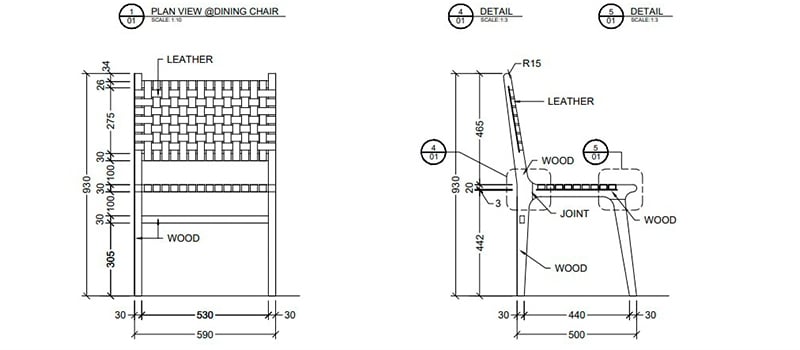
A chair drawn to millwork standards: one piece, one drawing, made to order.
Millwork shop drawing for a custom chair, made once for one interior
Shop drawing services are divided into millwork and casework, each having its own properties and therefore destined to serve different types of projects. So naturally, knowing how to choose the right type of drawing services will help Designers and Manufacturers to simplify their working process and get the best result.
Contents:
- What is the difference
- Definition
- Custom made
- Mass production
- Manufacturing process
- What casework means in construction
- Where Grade Comes Into It
- Costs
- Where cabinetry fits in
- Carpentry is not on this list
- All four at a glance
- Millwork vs Casework FAQ
A Designer wants to order custom furniture based on his design idea for a new project but is not sure what kind of contractors he needs to hire for this purpose. Google search showed thousands of results with millwork and casework companies but no explanations for the difference between them. The Designer wants to understand what type of woodwork services will be best for his specific project and what type of drawings he needs to choose for Furniture Manufacturers in order to get what he has in mind.
This problem can be easily remedied. As a company that offers shop drawings across all types of CAD drafts and has an experience of working with many Manufacturers, we can give a quick and informative comparison. So let’s learn the difference between millwork and casework, as well as find out what type of shop drawing suits your needs.
What Is the Difference Between Millwork and Casework?
The difference between millwork and casework comes down to customization. Millwork is custom woodwork produced in a mill for a specific project and space: trim, crown molding, wall paneling, doors, and made-to-order furniture. Casework is standardized, box-shaped woodwork such as cabinets, shelving, drawers, and storage units. It is built to fixed dimensions and often made for mass production. Simply put, casework relies on standard boxes and templates, while millwork is always tailored to one particular interior.
| Criteria | Millwork | Casework |
|---|---|---|
| What it is | Custom woodwork made for a specific project | Standardized box-shaped units (cabinets, shelving) |
| Customization | Fully custom, one-of-a-kind | Fixed standards, modular |
| Production | Made per order | Suited for mass production |
| Shop drawings | Detailed drafts based on unique design specifications, with multiple views of each item | Template-based, standardized drawings |
| Cost of drafting | Higher, as drawings need more detail and revisions | Lower, since templates can be reused |
Below, we break down each of these differences in detail. And if you already know what you need, head straight to our millwork shop drawing services.
The two sides of the difference on one screen. A panelled wall is millwork: it exists once, for this room. A linen cabinet is casework: a box built to standard sizes.
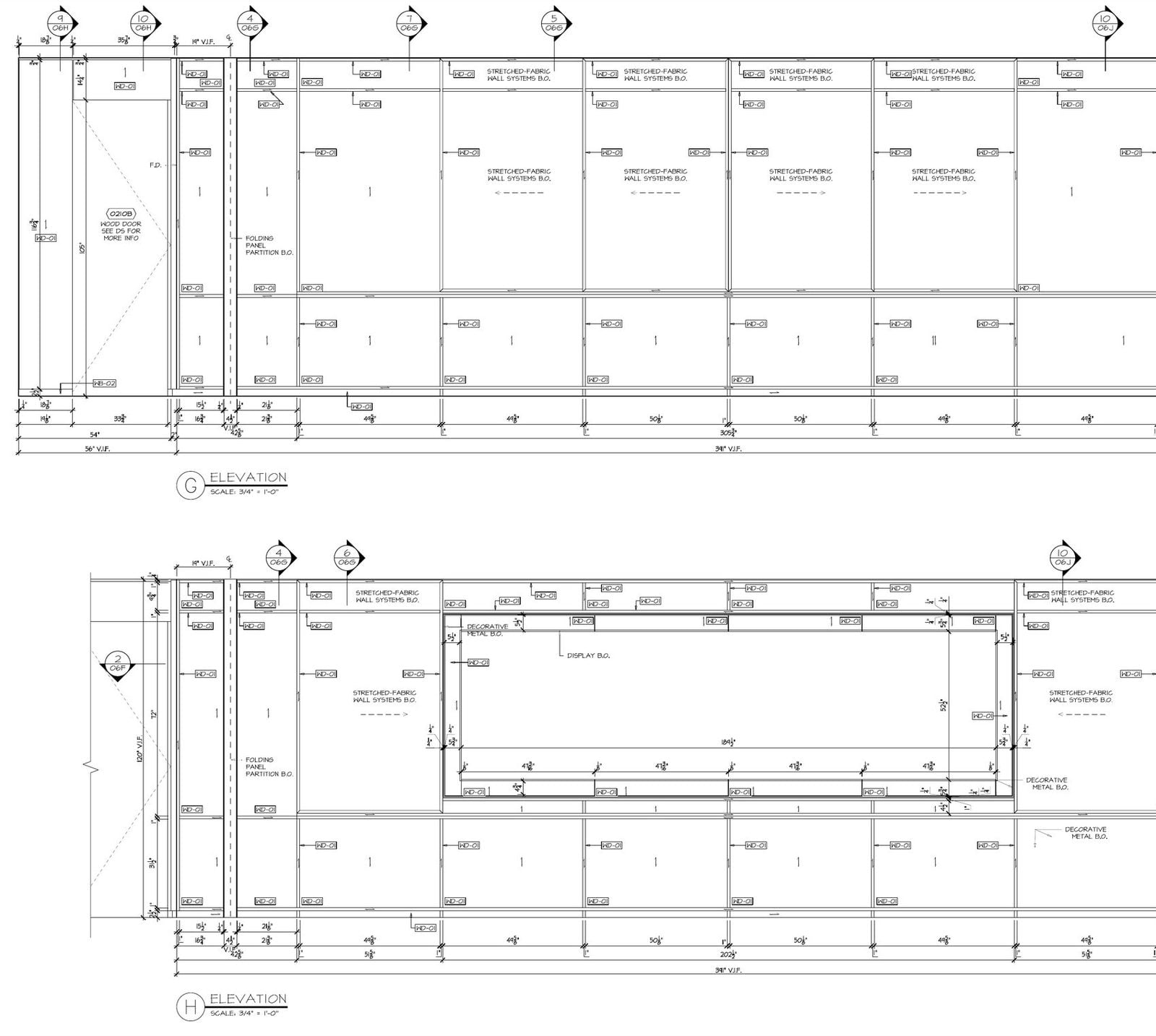
Wall panelling drawn as elevations, the kind of run that falls under millwork.
Millwork shop drawings: elevations of a panelled wall, drawn once for one room
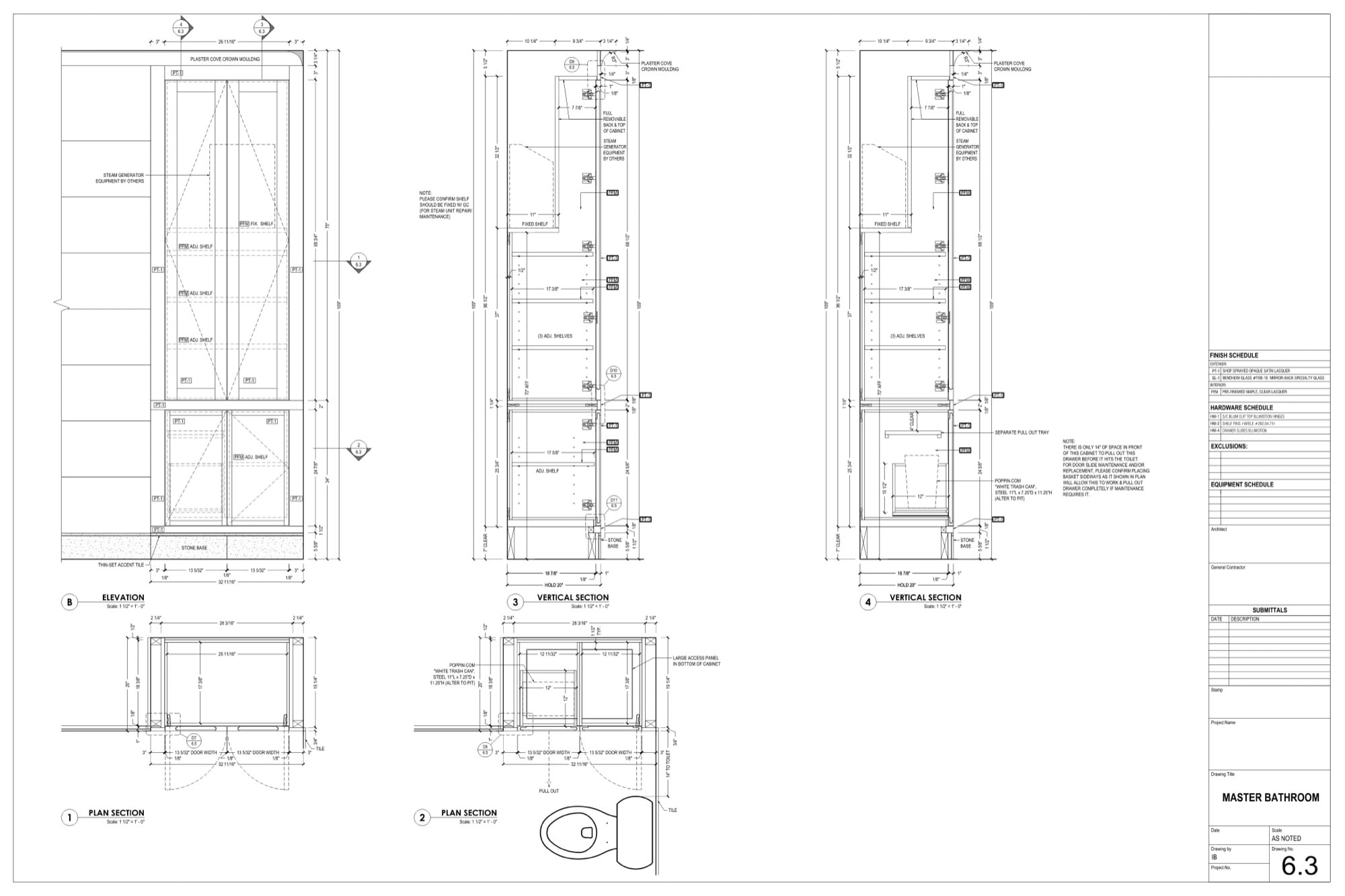
A linen cabinet drawn as casework: a box built to a standard size.
Casework shop drawings: a linen cabinet as a standard box, elevation and vertical section
#1. Definition
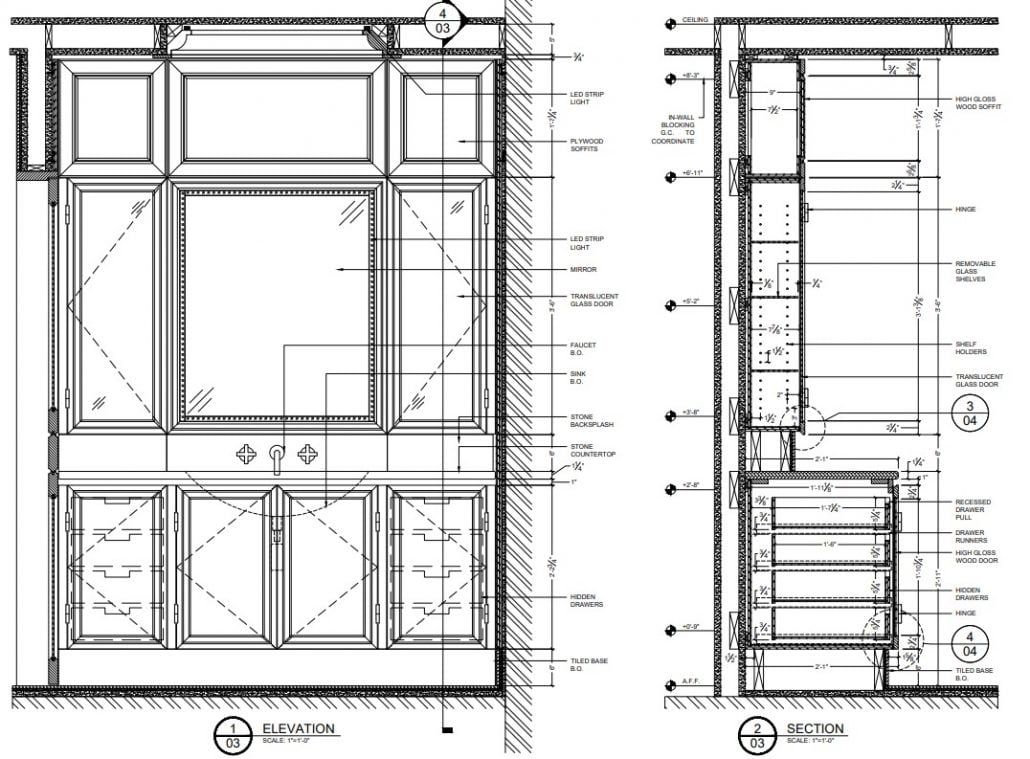
Generally speaking, millwork is any kind of woodwork and wooden products that are made in a mill. The full boundary, including where plain carpentry stops counting, is laid out in what millwork means on a project. It includes furniture, doors, windows, wall panels, crown and trim molding etc. However, ceiling, flooring and walls are not considered millwork, even if they are manufactured in wood. As for usage, millwork shop drawing services provide very detailed engineering and architectural drafts for Manufacturers, construction companies and other contractors that implement different design projects.
Now let’s examine casework drafting. Simply put, it is making wooden boxes. It includes all box-shaped objects and construction that are manufactured in a mill such as cabinets, racks, drawers, media-consoles, bookcases, storage spaces etc. Casework shop drawing services are used by furniture firms and mass-production companies as a part of their own business and sales.
#2. Custom Made
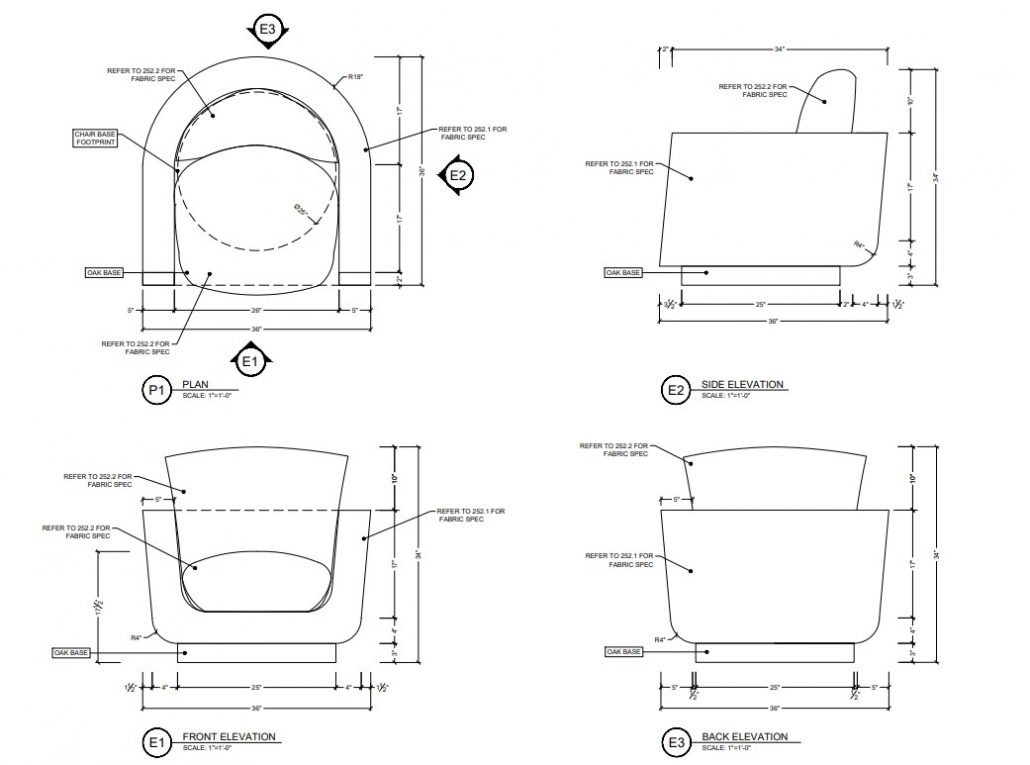
Millwork shop drawing services are orientated on custom products, and therefore require accurate dimensions, design sketches and drafts, reference pictures. They are ordered to manufacture a unique piece of millwork to fit into a certain space and are fully based on the Designer’s project. Thanks to that, each shop drawing is different from the other just like every final custom product in unique in its own way.
On the contrary, casework products are not suitable for custom manufacturing as they are made by fixed standards. Casework goods are also often used for modular purposes – as not finished pieces but rather a set of parts that are assembled by customers. Shop drawings for such products are based on manufacturing standards and not unique design ideas.
Want to know more about CAD services our studio provides? Check out this archive with projects examples and learn more.
#3. Mass Production
Millwork is not adapted to mass-production because its items and designs are made on the base of Designers’ requirements and dimensions. Moreover, they are made-as-per-order and one product is developed for one interior design project only. As a consequence, this type of shop drawing services provide exclusively unique millwork drafts that are not suitable for mass production due to the specific requirements made for a certain space.
Casework services make standardized pre-fabricated pieces that are very convenient for mass-production companies. Thanks to them, casework companies provide easy and ready-made storage options for quick use. Think of IKEA – they offer furniture with different color options, surface finishes and so on but a client can only choose pre-made models with certain dimensions instead of products made exclusively for them in one copy. Moreover, such shop drawing services don’t require any architectural drafts, design sketches as they are only based on standards of production.
#4. Manufacturing Process
As the custom manufacturing, millwork itself takes much longer than a mass-production item. The same goes for millwork shop drawings: they require many references such as all technical info, design sketches and drafts, sometimes examples of textures and materials. While making such drawing projects, draftsmen always have to ask for more details from Designers or Manufacturers and get their approval for every step.
Casework shop drawing services are much faster – just like the mass-production itself. Draftsmen usually take into account only certain production standards and use basic templates as well as previous similar drawings. Sometimes such shop drawings are created on the base of one template, and sometimes they are slightly modified previous casework drafts.
What Casework Means in Construction
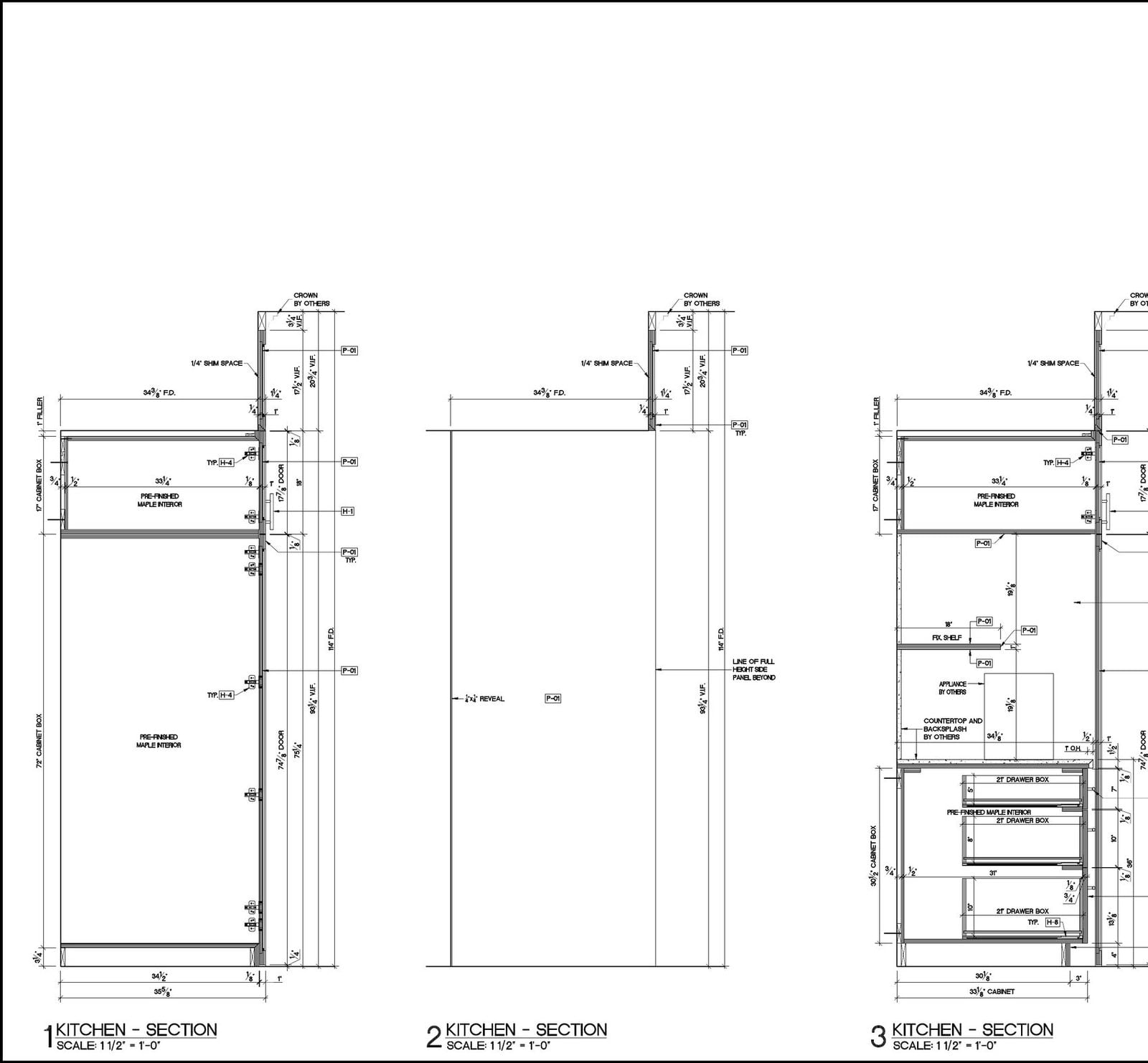
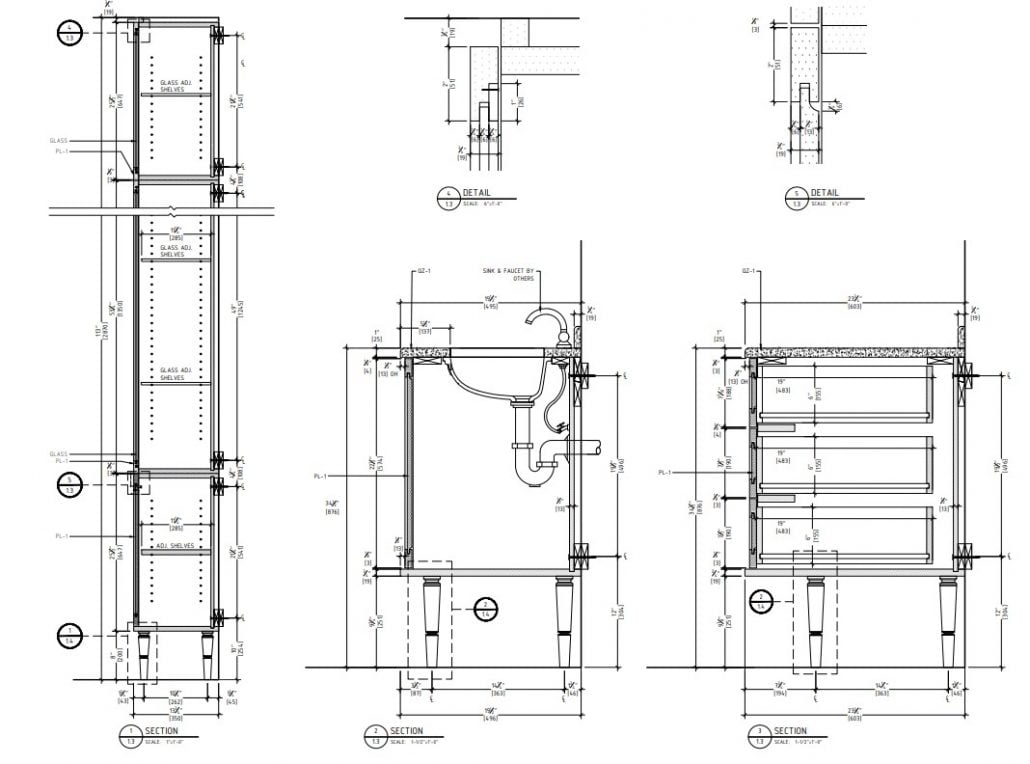
Kitchen cabinets in section: the carcass, the shelves and the hardware behind the doors.
Cabinet shop drawings: vertical sections through base and wall units, the boxes casework is built from
On a construction project, casework means the built-in boxes. Base cabinets, wall cabinets, tall storage, reception counters, nurse stations, teacher walls, lab benching. Anything assembled from a repeatable carcass and then finished, hung or set in place.
The word carries weight in specifications. Casework usually lives in Division 12 alongside furnishings, while architectural woodwork sits in Division 06. Two divisions, two sets of submittal requirements, sometimes two different suppliers on the same floor. Read the spec before assuming which one your package falls under, because the grade rules and the approval path differ.
Contractors also use casework loosely to mean the cabinet portion of a millwork bid, whoever ends up building it. That is fine in conversation and dangerous in a contract. When a schedule says casework and the drawings show a curved reception desk with a solid surface top, somebody is about to discover the estimate covered the wrong scope.
Manufactured casework changes the picture again. Factory lines produce standard modules to fixed dimensions, delivered flat packed or assembled. Cheaper per unit, faster to deliver, and inflexible the moment a wall is out of plumb. Custom casework absorbs that problem; the standard module does not.
Where Grade Comes Into It
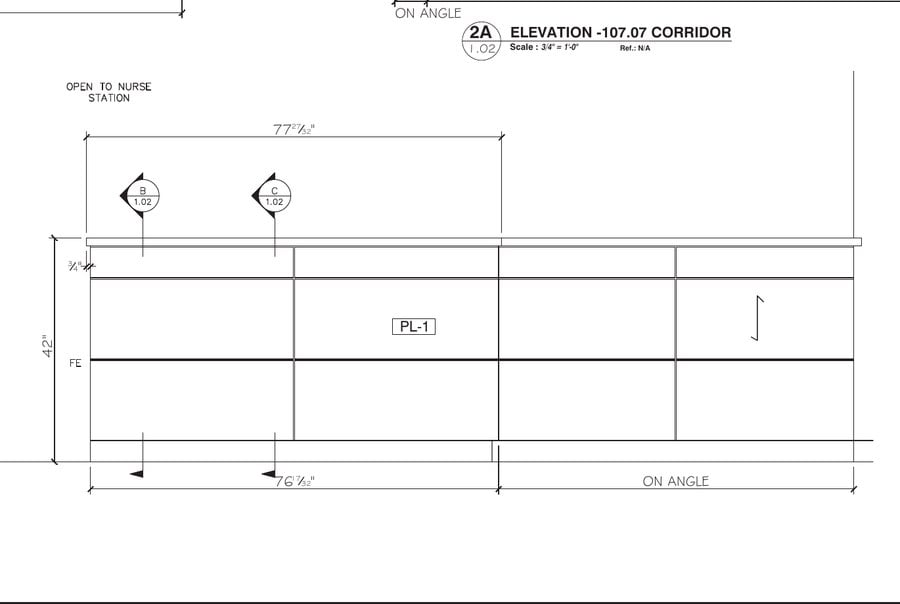
A corridor elevation showing where panelling stops and cabinetry starts.
Economy grade millwork: a corridor casework elevation at the level of detail the grade calls for
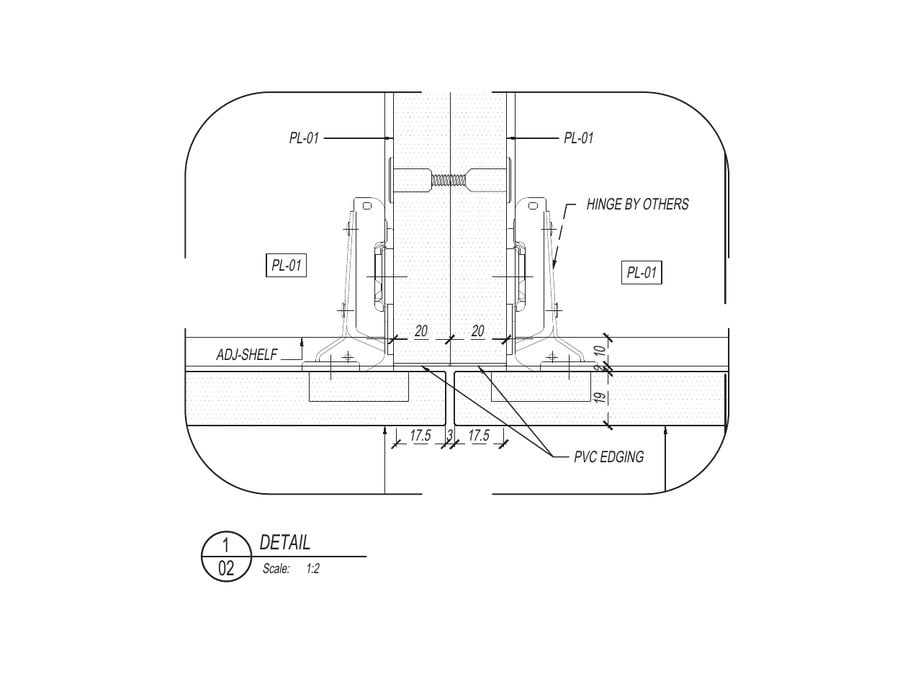
A joinery detail at 1:2, the level of drawing millwork asks for.
Premium grade millwork: a joinery detail at 1:2 scale, where every reveal and edge is drawn exactly
Millwork and casework are also priced differently because they are usually specified to different grades. The Architectural Woodwork Standards define three: Economy, Custom and Premium.
Casework tends to sit at Custom, since a modular box built to a repeatable standard is exactly what that grade describes. Bespoke millwork is where Premium turns up, and with it matched veneer, tighter tolerances and a drawing set that has to show a good deal more. Reading the spec before quoting saves the awkward conversation later, because the same cabinet run costs differently at each grade.
#5. Costs
Serving custom-made projects, millwork shop drawing services often cost more than casework drawings due to more efforts and time put in such projects. This kind of drafts include all specific requirements, detail and adjustments as well as clients’ full control over the process. Moreover, Designers can add, change and include everything that is needed to complete a project at any moment.
As a standardized product, casework costs less and it’s reflected on its shop drawing services. Usually, such drafts are simpler and contain standard elements, shapes and designs. When it comes to the payment per hour, such drawings take less working time which means less money. In addition, one version of this kind of drawing can be used for a bunch of products.
The main difference between millwork and casework shop drawing services is that the first one is custom-made and the second one is standardized for mass-production. Millwork shop drawings are based on unique design ideas and specifications, while casework drawings are only regulated by manufacturing standards . If a Designer aims for utility, speed and cost reduction in his project, than casework services are the best option. However, in case he wants a unique product that perfectly fits into a certain space and enhances the quality of his interior design, millwork shop drawing services are a more effective option.
Where Cabinetry Fits In
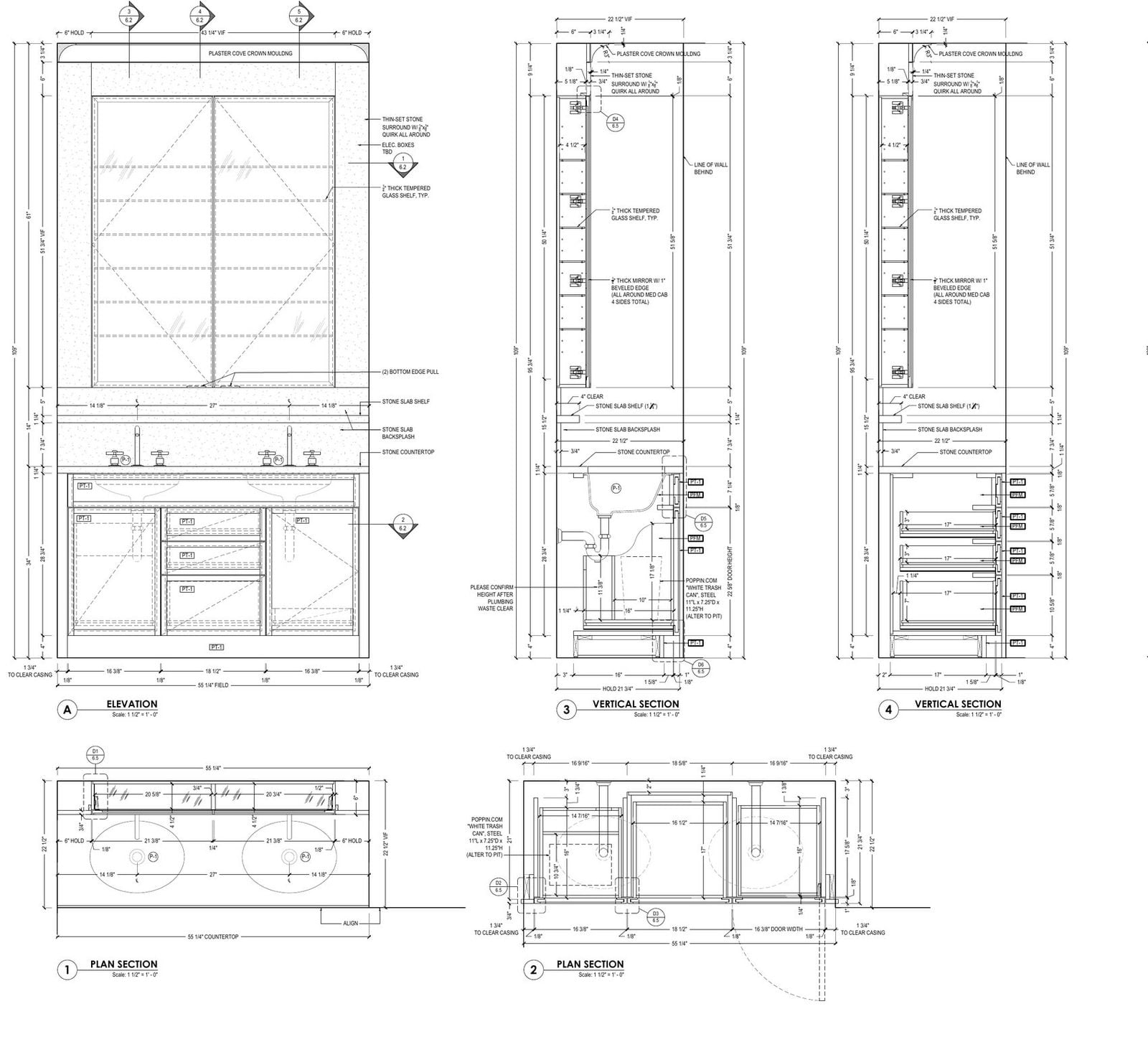
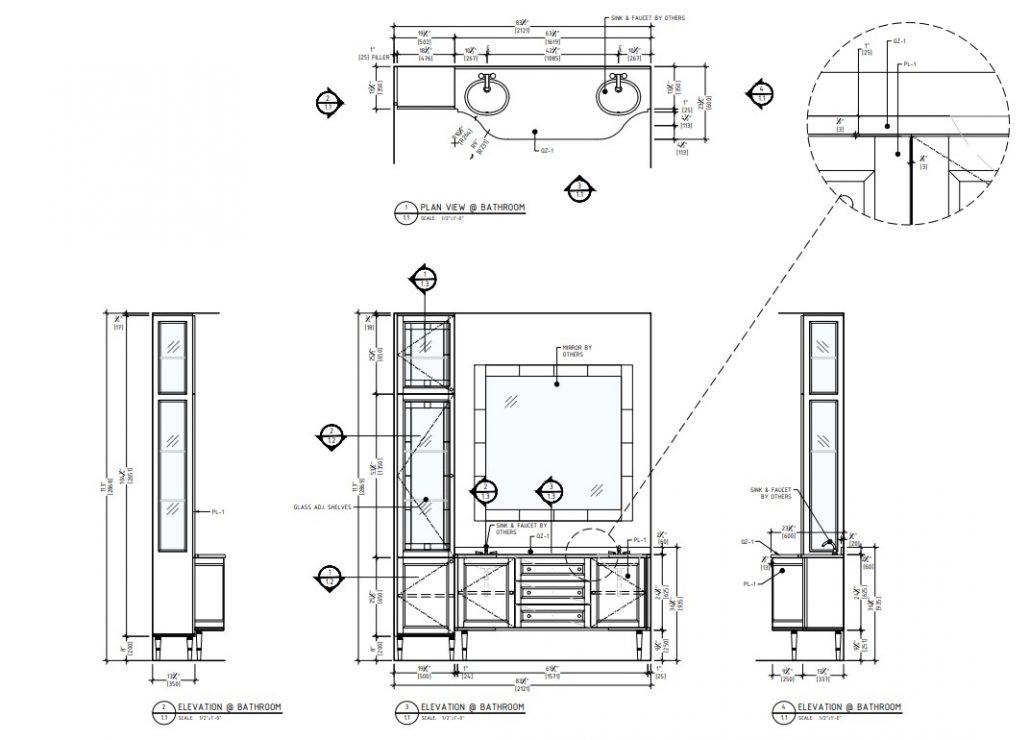
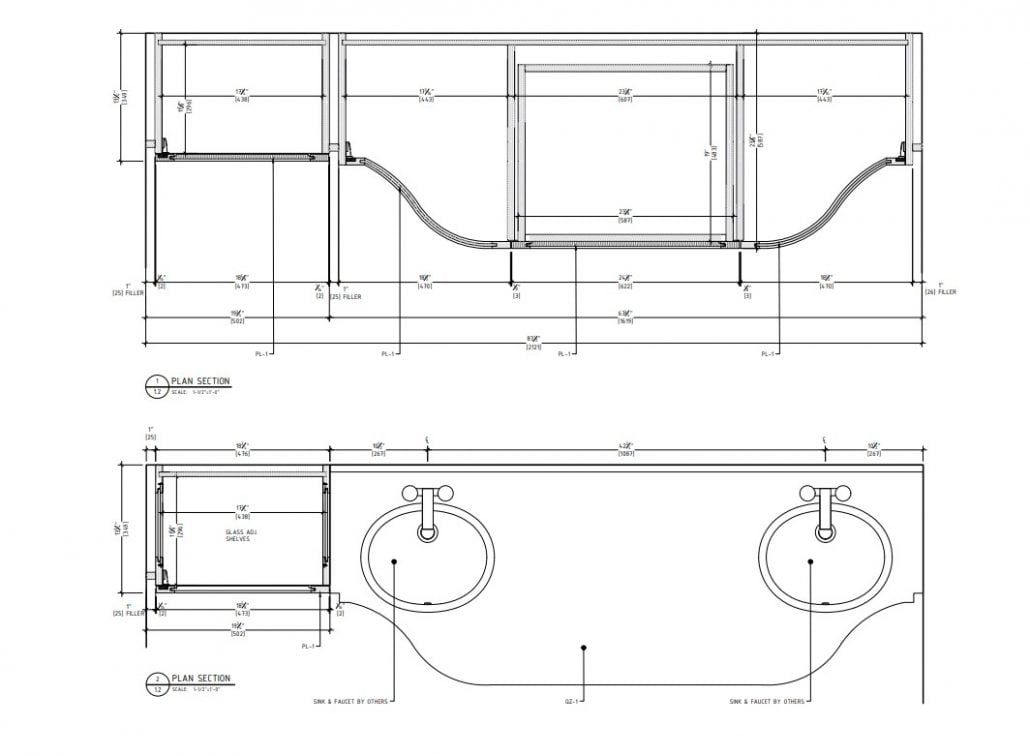
A vanity elevation with the dimensions a shop cuts to.
Bathroom vanity shop drawings: elevation with vertical and plan sections, the cabinetry clients ask about
Cabinetry never shows up in a spec book, yet every client says it.
It sits inside casework, not beside it. A kitchen run is cabinetry. So is a vanity. So is a wall of storage in an office. All of it is casework too, because all of it is boxes.
Who is talking decides the word. Homeowners order cabinetry. Architects specify casework. The general contractor writes millwork on the schedule and means every wooden thing on the job.
Drafting barely notices the difference. Cabinetry sheets follow casework rules anyway: a section per box type, door and drawer schedules, overlays, reveals, hardware with part numbers on it. That is exactly what our cabinet shop drawings cover.
Scope is where it actually splits. Cabinetry is usually one room. Casework is a floor. Millwork is the building, paneling and trim included.
Carpentry Is Not on This List
Carpentry happens on site. Framing, blocking, hanging doors, scribing trim to a wall that was never straight to begin with.
Millwork happens in a shop and shows up finished.
Sometimes the same crew does both, which is where the confusion starts. The paperwork still splits: carpentry follows the architect’s drawings, millwork needs its own shop drawing set approved before anybody cuts anything.
Millwork, Casework, Cabinetry, Carpentry at a Glance
| Term | What it covers | Where it is made | Needs shop drawings? |
|---|---|---|---|
| Millwork | All custom woodwork: paneling, trim, doors, stairs, built-ins, casework | Shop | Yes |
| Casework | Box-based units: cabinets, shelving, lockers, storage walls | Shop | Yes |
| Cabinetry | Casework in kitchens, bathrooms and storage rooms | Shop | Yes |
| Carpentry | Framing, blocking, installing, on-site fitting | Site | No |
Wonder how much high-quality drafting services cost? Check out the examples of our real projects with pricing.
Want to get high-quality drawings for your type of project and manufacturing process? Contact ArchiCGI and use shop drafting services to get the most suitable drawings for your requirements.
Millwork vs Casework FAQ
Is cabinetry the same as casework?
Nearly. Cabinetry is the everyday word for kitchens and bathrooms. Casework is what architects write in specifications, and it stretches to reception desks, lockers and nurse stations. Same drawings either way.
What is architectural woodwork?
The formal name for millwork in specs and standards. When a spec references AWI grades, economy, custom or premium, it means architectural woodwork, and that covers paneling, trim, doors and casework alike.
What is the difference between carpentry and millwork?
Where the work happens. Carpenters cut and fit on site. Shops build to exact dimensions and deliver finished pieces, which is exactly why millwork needs approved shop drawings and site carpentry usually does not.
Which costs more, millwork or casework?
Millwork, almost always. Casework repeats standard boxes, so material and labour stay predictable. Millwork is one-off geometry with custom details, and both drafting and fabrication take longer per piece.

Stacey Mur
Content Writer, Copywriter
Stacey is a content writer and a CG artist. Outside of work, Stacey enjoys musicals, Star Wars, and art talk. A proud Corgi parent.


Great post!