
What CSI Division Is Millwork? Division 06 and When It Is 12
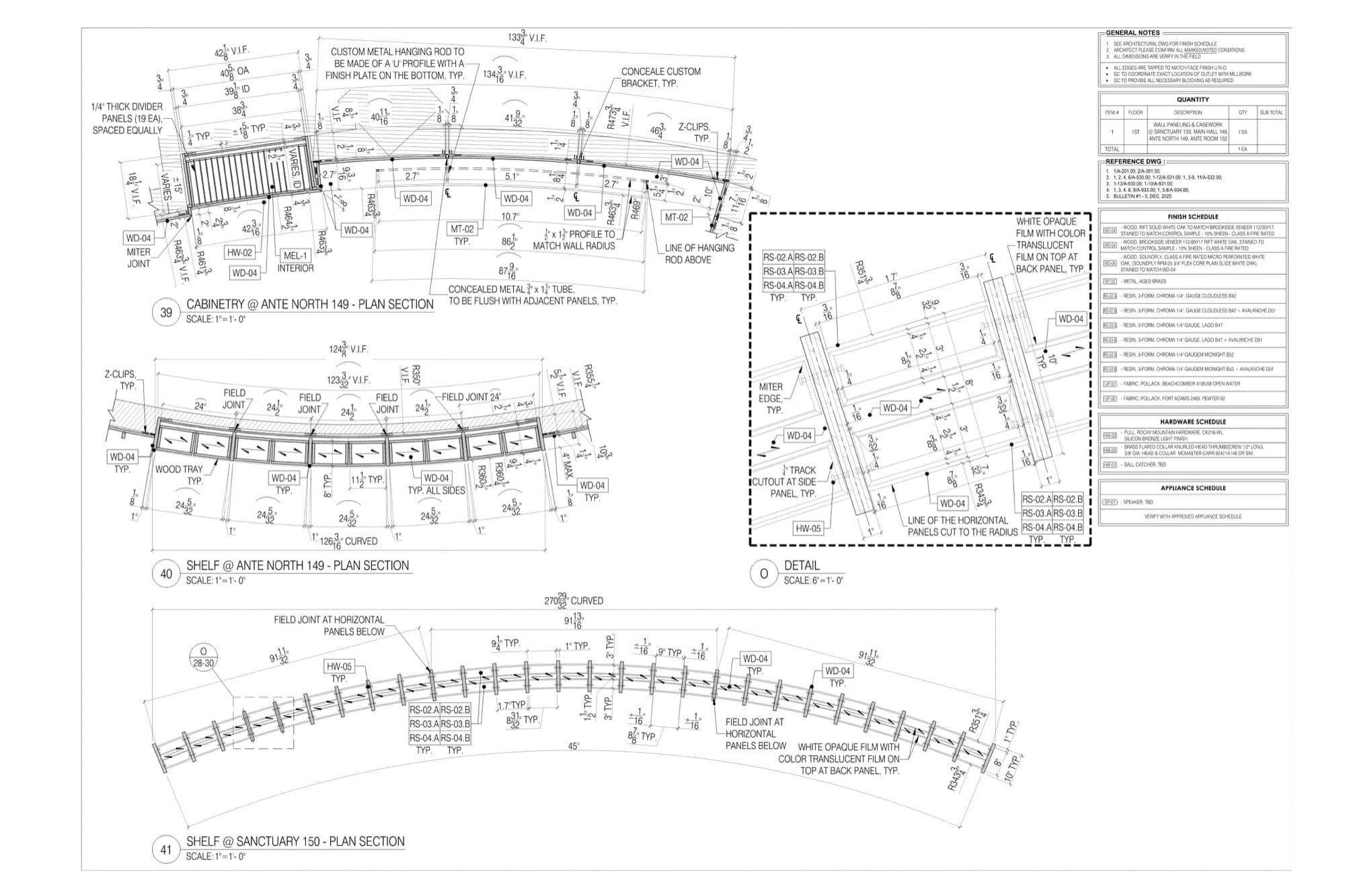
A millwork sheet carries the spec with it: finish schedule, hardware schedule and general notes sit on the same page as the drawing.
Millwork sits in Division 06, Wood, Plastics, and Composites, and almost always under section 06 40 00, Architectural Woodwork. If the cabinets arrive from a catalogue instead of a shop, the same items move to Division 12, Furnishings. That one distinction decides who draws the shop drawings, who signs off on the grade, and which trade carries the money in the estimate.
Below is what each division holds, how to tell in ten seconds which one a scope falls under, and what a drafter pulls out of the spec before the first sheet gets drawn.
Contents:
- Why the number matters at all
- Division 06: where millwork lives
- Division 12: when casework moves out of 06
- The ten second test
- What is inside a millwork spec section
- What a drafter reads first
- Where people usually go wrong
- Millwork CSI FAQ
Why the number matters at all
CSI MasterFormat is the filing system American construction runs on. Every product, material and scope of work gets a six digit number, and every specification book is organised by those numbers. A subcontractor bidding a job does not read the whole book. They open the divisions that belong to them and price what is inside.
That is why the number is not paperwork. Put custom paneling in Division 12 and the millwork shop never sees it, because they were only sent Division 06. Put manufactured lab casework in Division 06 and a custom shop bids work a factory was going to supply anyway. Both mistakes surface late, usually during submittals, when somebody asks why two trades are quoting the same wall.
Division 06: where millwork lives
Division 06 covers wood, plastics and composites, from the framing nobody sees to the finished woodwork everybody does. Four sections concern millwork.
06 20 00, Finish Carpentry. Trim, running mouldings, base and casing installed on site. Simpler profiles, usually stock.
06 40 00, Architectural Woodwork. The main address. Custom cabinets, reception desks, wall units, built-in seating, anything drawn for a specific project and built to those drawings.
06 41 00, Architectural Wood Casework. Casework built as architectural woodwork rather than bought as a product. Base and upper cabinets, counters, nurse stations, teller lines.
06 42 00, Wood Paneling. Wall panels, wainscoting and veneer wall systems where the panel layout and grain match are drawn.
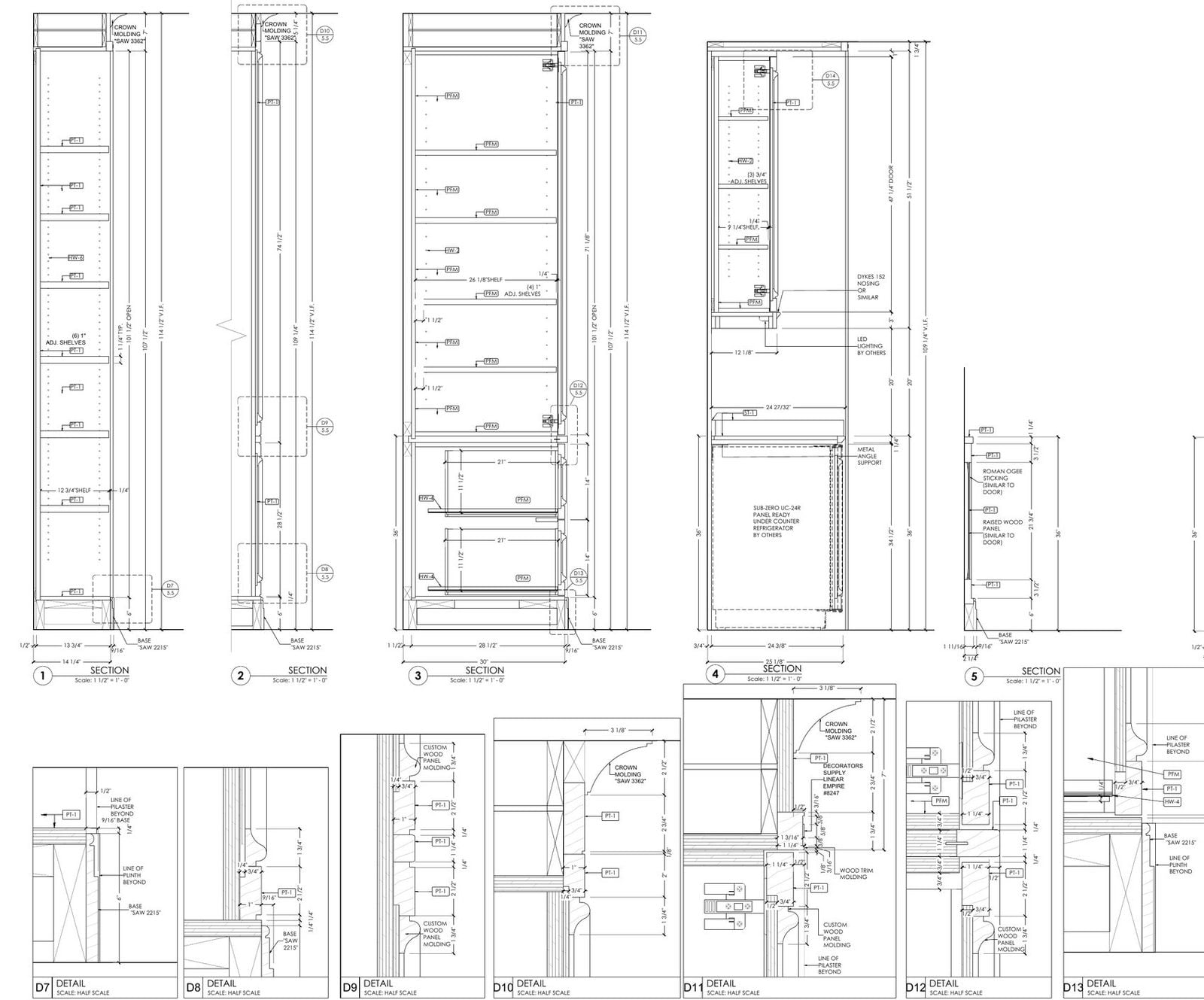
Architectural woodwork under 06 40 00: sections and profile details that only exist for this project.
If the scope is custom, made from shop drawings, and graded against the Architectural Woodwork Standards, it belongs here. That is the short version.
Division 12: when casework moves out of 06
Division 12 is Furnishings, and it holds casework that arrives as a manufactured product: modular cabinet systems, educational casework, healthcare casework, laboratory casework. The factory has a catalogue, standard sizes, published finishes and its own engineering. The project picks from that catalogue.
The line between the two is not the material, and not how it looks once installed. It is who engineers it. Division 06 work is engineered for this project by the shop that builds it. Division 12 work was engineered once, at the factory, and the project selects a configuration. The distinction runs deeper than the wording, which is why millwork and casework are not interchangeable terms on a spec sheet.
One building often has both. The lab benches come as Division 12 casework, and the reception desk in the lobby is Division 06 millwork. Nothing wrong with that, as long as the spec says which is which.
The ten second test
Four questions sort almost every scope.
Is there a catalogue number? If the item can be ordered by model, it is Division 12. If it can only be described by drawings, it is Division 06.
Who produces the shop drawings? Custom millwork gets project specific sheets from the fabricator. Manufactured casework gets product data and a layout plan.
Is a woodwork grade specified? Economy, Custom or Premium against the Architectural Woodwork Standards means Division 06. Manufactured casework is specified against the manufacturer’s own standards instead.
Who carries it if a dimension is wrong? On custom work the shop does, because the shop measured and drew it. On manufactured casework the risk sits with whoever set out the layout.
What is inside a millwork spec section
Every MasterFormat section is written in three parts, and each part answers a different question.
Part 1, General. Administration. Submittal requirements, sample sizes, quality assurance, warranty, delivery and storage conditions. This is where a shop finds out how many sets to send, whether samples come before or with them, and how long review takes.
Part 2, Products. Materials. Grade, core and substrate, veneer species and cut, laminate, edge treatment, hardware manufacturers and models, finish system.
Part 3, Execution. Installation. Tolerances, anchoring, scribing to field conditions, cleaning, protection until handover.
What a drafter reads first
We draw from these sections every week, and the reading order is always the same, because five things change the drawings and everything else changes the price.
The grade. Economy, Custom or Premium decides how much has to be shown. Premium needs joinery detailed, veneer sequence drawn and reveals dimensioned. Economy does not.
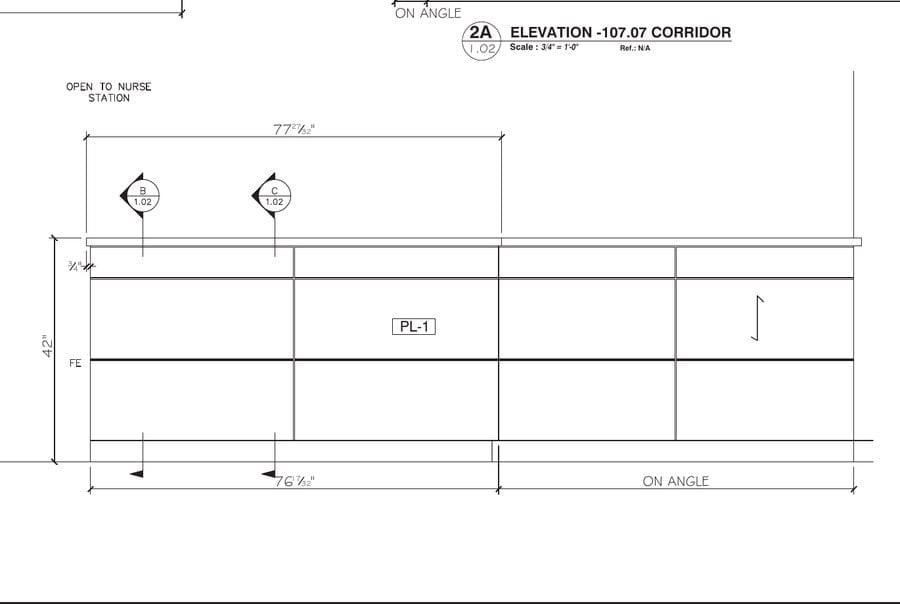
Economy grade: overall sizes and a laminate tag are enough, the shop fills in the rest.
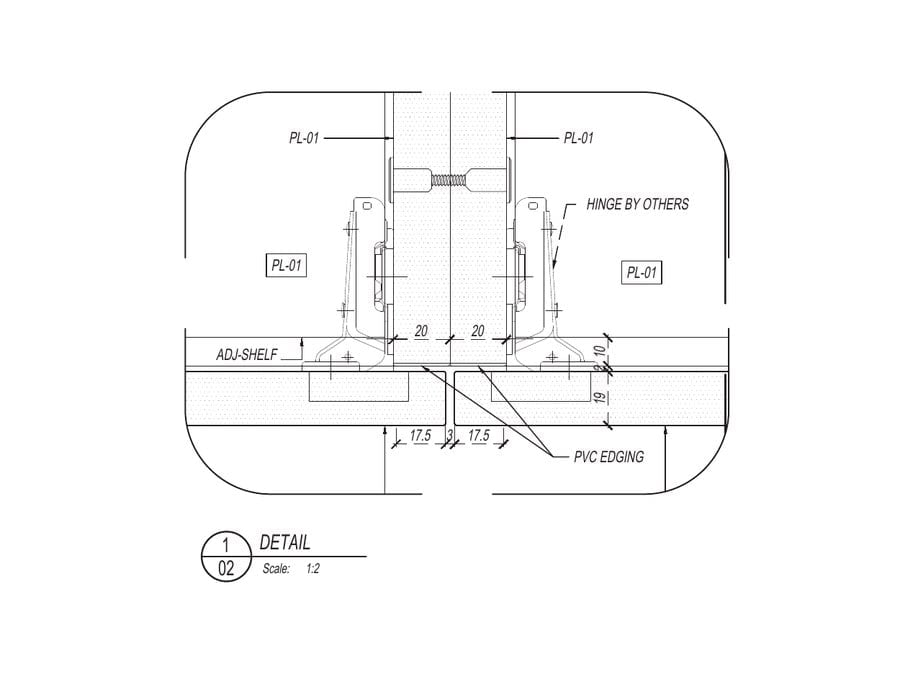
Premium grade: the same cabinet needs the hinge, the edging and the panel core drawn at 1:2.
Substrate and core. Particle board, MDF or plywood changes edge details and how hardware is anchored.
Veneer and grain requirements. Sequence matched, book matched, running match. This drives elevations and panel layouts more than any other line in the spec.
Hardware. Named manufacturers and models set the clearances. Undermount slides and blind corner units eat different amounts of a cabinet.
Submittal requirements. How many sheets, at what scale, in what format, how many review rounds. Missing this line is the fastest way to redraw a package. It is also the part most worth pinning down in the brief you send a drafting team.
Everything else is a cost item rather than a drawing item. Once those five are on the sheets, the shop can build.
Reading the spec is half the job. Turning it into sheets a shop can cut from is the other half, and that is what our millwork shop drawing services cover.
Where people usually go wrong
Millwork against casework. The words are used loosely on site, but in a spec they carry different addresses. Millwork is custom woodwork. Casework is cabinet boxes, which may be either custom under 06 41 00 or manufactured under Division 12. If the wording on a drawing set is unclear, it helps to settle what counts as millwork before the bid goes out.
Division 06 against Division 09. Finishes applied on site, paint and stain done in the field, live in Division 09. Factory finish on a millwork item stays in Division 06, inside the millwork section.
Division 06 against Division 08. Wood doors are usually Division 08 with the rest of the openings, even though they are wood and the same shop may supply them. Door frames and casing that form part of a millwork assembly stay with the millwork.
Splitting one assembly. A reception desk with a solid surface top sometimes gets split, the desk in 06 and the top elsewhere. Two trades, one object, and a joint nobody owns. If it is one built object, keep it in one section.
Millwork CSI FAQ
What CSI division is millwork?
Division 06, Wood, Plastics, and Composites. The millwork itself usually sits under 06 40 00, Architectural Woodwork. Rough carpentry and blocking share the same division, so naming Division 06 on its own tells a bidder very little. The section number does the real work. It is what separates a trim carpenter from the shop that will build your cabinets. And if the job buys manufactured casework instead, that scope leaves Division 06 altogether and gets priced by somebody else under Division 12.
What is the CSI code for architectural woodwork?
06 40 00. Below it the numbers get narrower. Base and upper cabinets, counters, nurse stations and teller lines fall under 06 41 00. Wainscoting and veneer wall systems go to 06 42 00. Trim that a carpenter installs on site is 06 20 00 instead. On a small job you may see nothing but 06 40 00 for the entire millwork package, and there is nothing wrong with that.
Is casework Division 6 or Division 12?
Both. It depends on how the cabinets are bought, not on how they look once they are hung. Built to your drawings by a millwork shop, they are Division 06, usually 06 41 00. Ordered from a manufacturer catalogue, they are Division 12. Ask one question: does it have a model number? If yes, Division 12. If the only way to describe it is a drawing, Division 06. Put it in the wrong place and the package goes to a bidder who cannot build it, which tends to come out at submittal, when two trades are quoting the same wall.
Which division covers laboratory and healthcare casework?
Division 12, in most cases. Lab benches, fume hood bases and exam room units arrive as product lines, with published sizes, chemical resistant tops and engineering already done at the factory. The project picks a configuration. But walk down the corridor of the same building and the reception desk was drawn for that floor and nothing else, so it stays in Division 06. Hospitals and schools carry both, which is exactly why the spec has to be explicit.
Does the CSI division change what goes on shop drawings?
Completely. Division 06 needs shop drawings made for this project: plans, elevations, sections cut through the carcass, joinery, and dimensions somebody took on site. Division 12 usually needs product data, finish selections and a plan showing where each unit lands. Even the review runs differently. Custom sheets come back marked up and get redrawn, sometimes twice. Product data gets a yes or a no.
What is AWI premium grade?
Premium is the top grade in the Architectural Woodwork Standards. Custom sits under it, Economy under that. What you buy at Premium is tighter tolerance and much stricter rules on veneer: how it is matched across a run of doors, how the grain carries from one panel to the next. Visible joints get almost no forgiveness. For whoever draws the set, that means the sheets have to say everything. Joinery detailed, veneer sequence drawn, reveals dimensioned. At Economy the shop is trusted to sort most of it out on the floor. Your spec names the grade, and the section above covers what each one changes on the drawings.
Wonder how much high-quality drafting services cost? Check out the examples of our real projects with pricing.

Nathalie Paul
Blog Writer
Nathalie is a senior draftswoman at ArchiCGI. She loves the fine art of creating quality drawings. After work, Nathalie is passionate about Ishvara yoga, traveling, and strong bitter coffee.


Leave a Reply
Want to join the discussion?Feel free to contribute!