
Architectural Drawings Explained: The Sheets in a Set, From Site Plan to Details
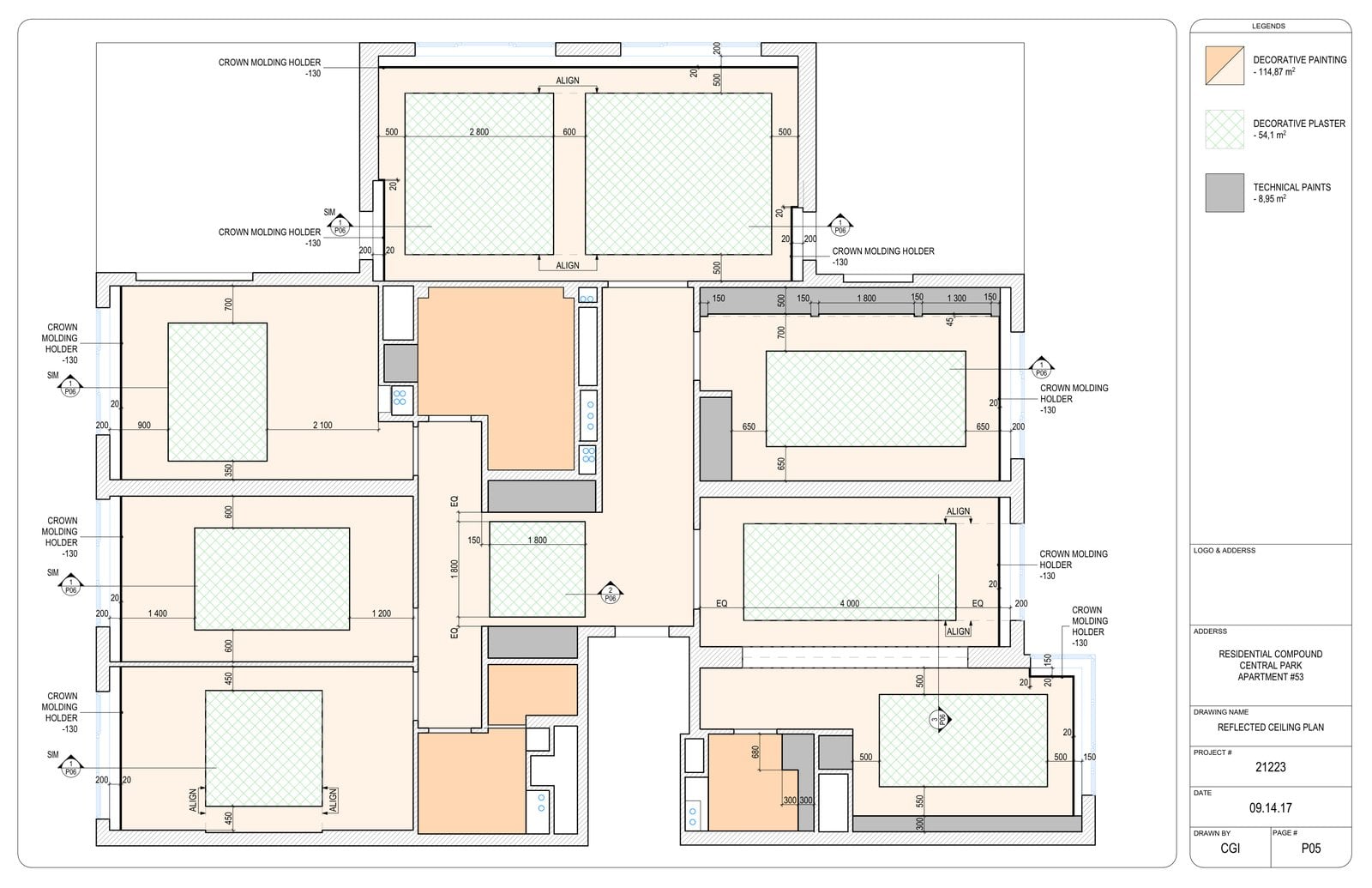
Sheet P05 from a 24 sheet apartment set we drew. Ceiling finishes in color, section marks around the walls, title block on the right.
Architectural drawings are the scaled, dimensioned drawings that describe a building: where it sits, how the rooms are laid out, what it looks like and how its parts go together. A full set splits that into plans, elevations, sections, details and schedules, each on its own numbered sheet.
We’re a drafting studio, and finishing sets that other people started is a normal part of the job. So this guide is written from the side that draws the sheets. We’ll go through the types of drawings, open up a real 24 sheet set we drew, and show how to read one without getting lost between sheets.
Contents:
- What architectural drawings are
- Types of architectural drawings
- A real drawing set, sheet by sheet
- How to read architectural drawings
- What architectural drawings usually leave out
- Who draws them, and where a drafting studio fits
- What architectural drawings cost
- Architectural drawings FAQ
What architectural drawings are
They go by a lot of names. Architectural plans, architect drawings, a drawing set, CDs, and on job sites people still say blueprints. Technically a “plan” is only the view from above, but in everyday talk “the plans” means the whole package. The set is what the owner approves, what the contractor prices, and what the crew builds from, so it has to answer the same questions for all three.
Architectural drawings vs blueprints
A blueprint was a printing method. Copies came out as white lines on blue paper, and the name stuck long after the process died. Nobody prints them that way now. The sheets you get are PDFs or plots on white paper, but if a contractor asks for the blueprints, they mean the current set.
Architectural, structural and construction drawings
Architectural drawings are one part of a bigger stack. Here’s who draws what on a typical US job:
| Sheets | What they show | Who usually prepares them |
|---|---|---|
| A sheets, architectural | Layout, walls, openings, heights, finishes, how the building looks | Architect or building designer |
| I sheets, interiors | Interior layouts, ceilings, finishes, interior elevations | Architect or interior designer |
| S sheets, structural | Foundations, framing, beams, connections | Structural engineer |
| M, E, P sheets | Mechanical, electrical and plumbing systems | MEP engineers |
| Construction documents | All of the above plus the specifications | The whole design team |
Who draws which sheets on a typical US project.
When everything is put together with the specifications, you have the construction documents. The architectural sheets sit in the middle of that set and the other disciplines draw over them.
Types of architectural drawings
Most lists online throw views, stages and disciplines into one bag. It’s easier to think of it the way a set is organized. First, what kind of view is it? Then, how far along is the design? Here are the views, with the scales we see most often on US work. Offices do vary.
| Drawing | What it answers | Typical US scale |
|---|---|---|
| Site plan | Where the building sits on the lot | 1″ = 20′-0″ or 1/16″ = 1′-0″ |
| Floor plan | Rooms, walls, openings, dimensions | 1/4″ = 1′-0″ |
| Reflected ceiling plan | Ceiling heights, lights, soffits | 1/4″ = 1′-0″ |
| Exterior elevation | What each face of the building looks like | 1/4″ or 1/8″ = 1′-0″ |
| Interior elevation | What each wall of a room looks like | 1/4″ or 1/2″ = 1′-0″ |
| Building section | Floor to floor heights, how levels stack | 1/4″ = 1′-0″ |
| Wall section | Every layer of one wall | 3/4″ or 1-1/2″ = 1′-0″ |
| Detail | One corner, joint or edge, drawn big | 1-1/2″ or 3″ = 1′-0″, half or full size |
| Schedules | Doors, windows, finishes in table form | No scale |
The views you’ll find in most sets, with the scales we see most often. Offices do vary.
Site plan

The site plan of a house: footprint, drive, pool and planting on the lot.
The site plan looks down at the whole lot. Property lines, setbacks, the footprint of the building, driveways, walks, the main levels. It’s the first sheet the building department looks at. Grading, utilities and storm drainage usually live on the civil engineer’s C sheets, not here, and we don’t draw those.
Floor plans
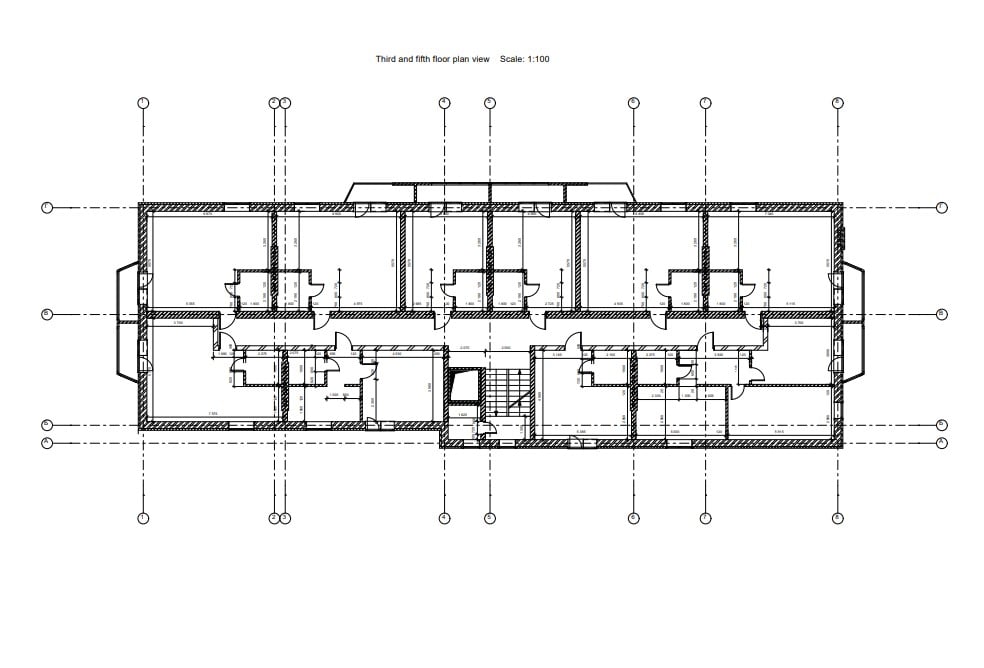
One floor of an apartment building, with grid lines and dimensions to the walls.
A floor plan is a horizontal cut through the building at about four feet, looking down. Walls, doors, windows, rooms, dimensions, door tags. On a renovation you’ll get two of them, a demolition plan showing what comes out and a new plan showing what goes in. If you only need the layout side of this, we’ve written separately about floor plan work.
Reflected ceiling plan
The RCP is the ceiling drawn as if the floor were a mirror. It shows ceiling heights, soffits, lights, diffusers and anything else up there. The cover image of this article is one, from the apartment set we’ll open below, with the ceiling finishes colored in.
Elevations

Main elevation of the same kind of building. No perspective, levels marked on the side.
Exterior elevations are a straight side view of each face of the building, with heights, openings and materials. They aren’t a rendering, so there’s no perspective and no shadows. Interior elevations do the same for walls inside a room, and on an interior job they make up half the set. More on that in our guide to elevation drawings.
Sections

Section through the building from foundation to roof, with the stairs cut through.
A building section slices the whole building top to bottom to show floor to floor heights, the roof and how the levels stack. Wall sections zoom in on one wall and show every layer in it. Our article on section drawing goes into how to cut them so they’re actually useful.
Details

A stair section through every floor, with three handrail details drawn bigger.
Details are the close ups. A stair, a window head, a threshold, a ceiling edge. In US sets they’re usually drawn at 1-1/2 or 3 inches to the foot, sometimes half or full size. If you work in CAD, the AutoCAD scale factor for each of those is worth knowing by heart.
Schedules
Tables instead of pictures. Doors, windows, finishes, sometimes lighting fixtures and plumbing fixtures. Each one is tied to a tag on the plans. The door schedule is the one that causes the most trouble when it drifts away from the plans.
By stage: concept to record
The same views get drawn several times as a project grows up. Concept and presentation drawings sell the idea. Schematic design fixes the layout. Design development adds sizes, materials and systems. Construction documents are complete enough to price and build from. And after the job, record or as-built drawings show what was actually built. Only the construction set should go to a crew.
A real drawing set, sheet by sheet
Here’s the index of an apartment interior set our team drew. It’s a residential job, 24 sheets, metric, from a few years back, and you can download the whole sample set as a PDF. We picked it because it shows how the sheets depend on each other, not because it’s big.
| Sheet | Title | What it is for |
|---|---|---|
| P01 | Field dimension plan | Measured walls and openings everything else is drawn on |
| P02 | Furniture layout | Furniture and ceiling heights by room |
| P03 | Partition dismantling layout | Walls that come out |
| P04 | Partition mounting layout | New walls and their sizes |
| P05 | Reflected ceiling plan | Ceiling levels, finishes, section marks |
| P06 | Ceiling sections | Ceiling edges and crown moldings |
| P07 | Crown molding plan | Where each molding profile runs |
| P08 | Lighting plan | Fixtures and chandeliers |
| P09 | Electric switches layout | Switch locations and heights |
| P10 | Electric switches schedule | Which switch controls which light |
| P11 | Electrical outlet layout | Outlet locations and heights |
| P12 | Plumbing layout | Fixture positions and connection points |
| P13 | Air conditioning layout | Indoor unit positions |
| P14 | Flooring plan | Floor finishes and joints |
| P15 | Floor heating layout | Heated floor zones |
| E00 | Elevation key plan | Which wall each elevation shows |
| E01 | Children’s bedrooms | Walls of both bedrooms with finishes and moldings |
| E02 | Study and master bedroom | |
| E03 | Living room | |
| E04 | Kitchen and dining | |
| E05 | Hall | |
| E06 | Bathroom | |
| E07 | WC and shower room | Tile layout |
| E08 | Utility room | Tile layout |
Sheet index of the 24 sheet apartment set, put together from the sheets themselves.
A few things stand out. Plans come first and elevations second, and the elevations get their own key plan, E00, so you can find which wall each one shows. The electrical, plumbing and air conditioning sheets here are layouts. They show where the designer wants switches, outlets, fixtures and units. Sizing the systems behind them is an engineer’s job.
On commercial work you’ll usually see the US National CAD Standard way of numbering instead. A-201 means discipline A, sheet type 2, which is elevations, sheet 01. The disciplines come in a fixed order, G for general first, then civil, landscape, structural, architectural and interiors, with fire protection, plumbing, mechanical and electrical after them. Small residential sets often just run A1, A2, A3. Either works, as long as the index matches the sheets.
Sheet sizes
Most US sets are plotted on ARCH D, 24 by 36 inches, or ANSI D, 22 by 34. For checking, people print half size on 11 by 17. That’s why a good set says somewhere “do not scale”, because a half size print at 1/4 inch scale is really at 1/8.
How many sheets a set has
A single room might be three or four sheets. A house typically runs 15 to 30. An office interior is often 15 to 40, and a large commercial building can go into the hundreds once every discipline is in. The apartment above lands at 24 because it’s an interior set with a sheet for each trade. Our article on residential architectural drawings covers what a house set usually holds.
Want to know more about CAD services our studio provides? Check out this archive with projects examples and learn more.
How to read architectural drawings
We read a set we’ve never seen in five passes. It sounds slow. It’s faster than finding out on site that you were looking at last month’s revision.
1. The title block
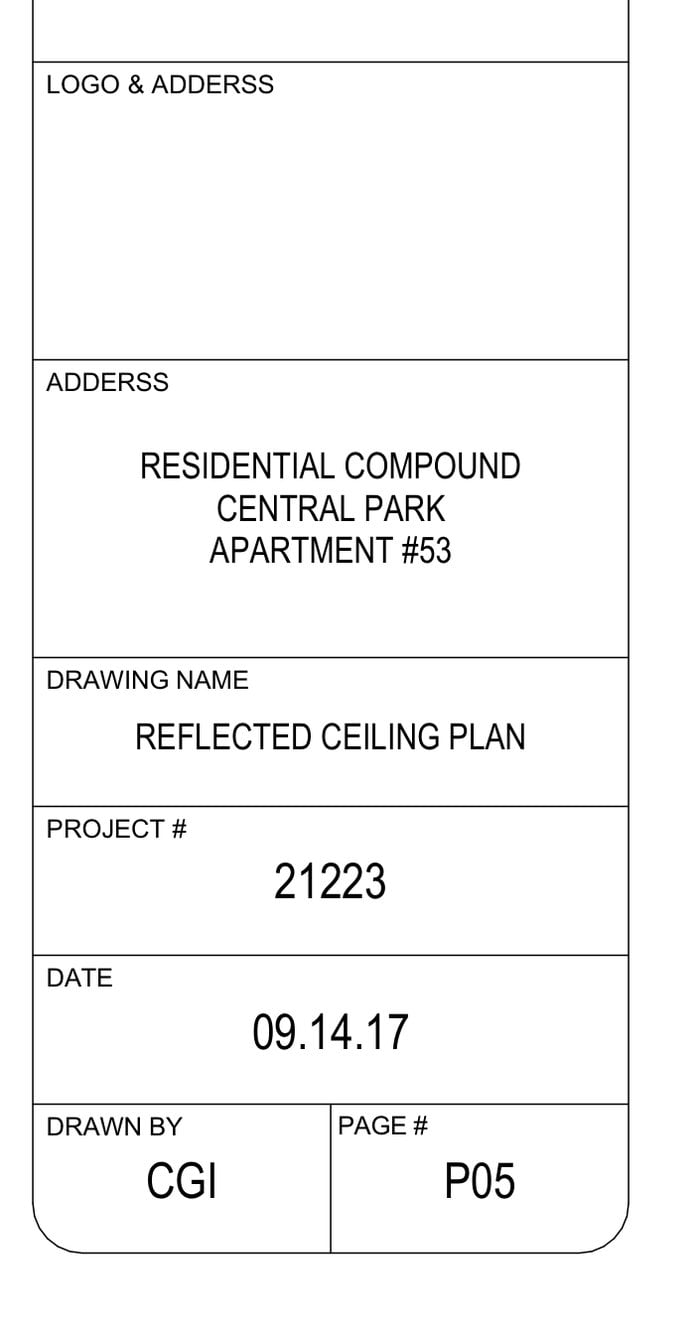
Title block from the same set. Sheet number bottom right, no revision box.
Start in the corner. The title block tells you the project, the sheet name and number, the date, who drew it, and on most sets the scale, the revision and the status, something like “not for construction”. Our 2017 template, above, is missing the revision box, which we’d never leave out today. If you can’t tell which revision you’re holding, stop and ask before doing anything else.
2. The index against the sheets you got
Check that every sheet in the index is in your hands and the dates make sense. A missing sheet is a common surprise. So is a sheet that’s there but older than the rest.
3. Legend, symbols and abbreviations
Every set has its own legend, usually on the first sheet or down the side of each one. On the apartment set it runs along the right edge, with finish swatches and molding profiles. Don’t guess what a symbol means from another project. Our piece on technical drawing covers the general conventions.
4. Follow the references
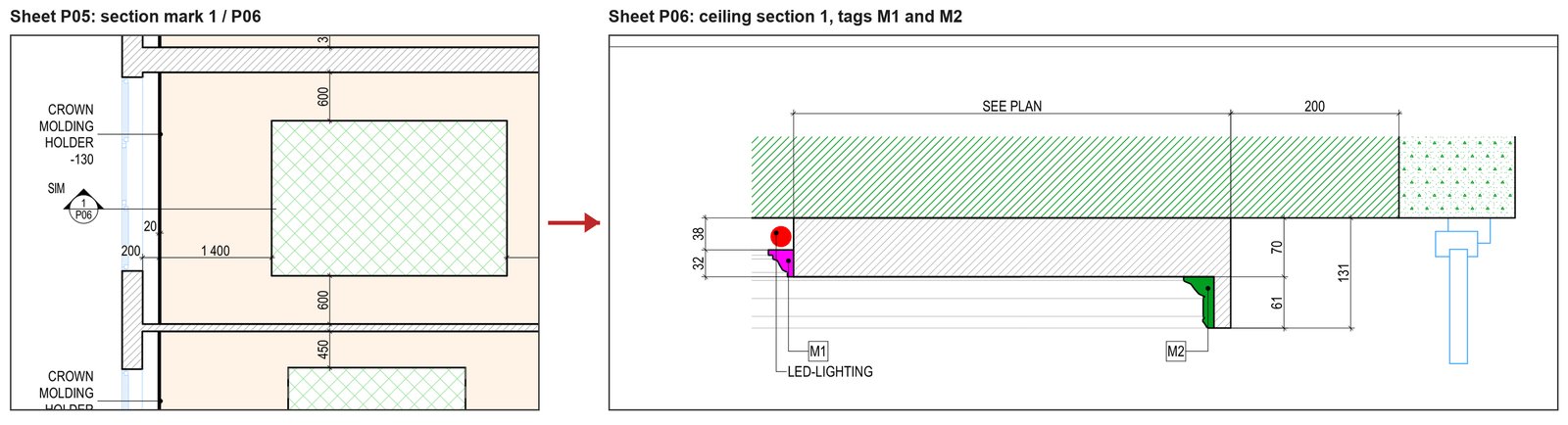
Section mark on the ceiling plan, and the section it points to two sheets later.
This is where most people get lost. A circle with a number over a sheet number is a pointer. On the ceiling plan above, “1 over P06” means “go to sheet P06 and look at section 1”. There the section shows the ceiling edge and two molding tags, M1 and M2, which take you to the legend with the actual profiles. Three sheets, one corner of a ceiling.
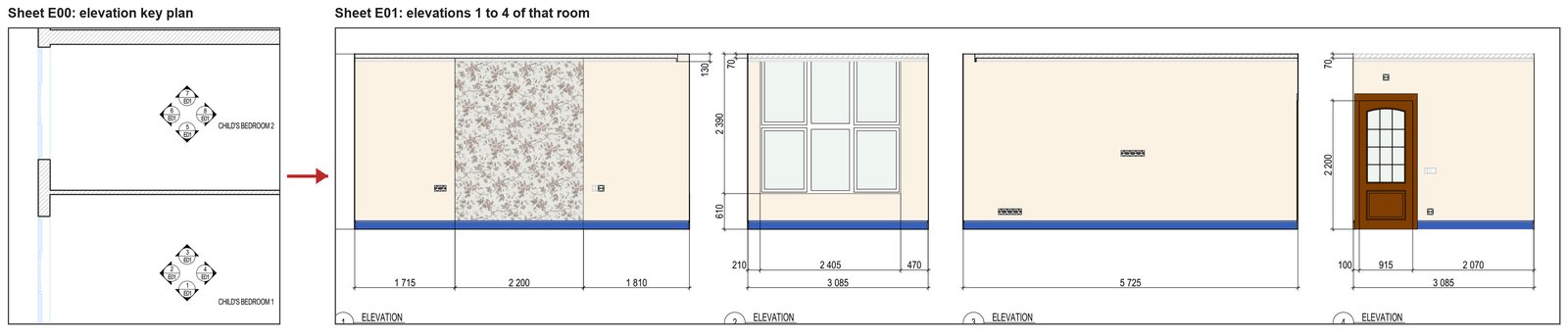
Key plan marker for one bedroom, and the four walls it points to on E01.
Elevations work the same way. The key plan E00 puts a small marker in each room, with arrows for each wall and the sheet they’re on. Child’s bedroom 1 points to views 1 to 4 on sheet E01. Once you’ve followed two or three of these by hand, the whole set starts to read like a map.
5. Dimensions
Look at where the dimension lines land. US framing plans are often dimensioned to the face of stud or to the centerline of a wall, not to the finished surface, and a note like CLR means a clear dimension between finishes. VIF means verify in field. And don’t scale a PDF on your screen. If a number you need isn’t written down, that’s a question for the architect, not a ruler. The sample set is metric, in millimeters, which is a good reminder to check the units before anything else.
What architectural drawings usually leave out
An architectural set describes the building. It doesn’t describe everything inside it, and the gaps are always in the same places.
Cabinets, built-ins and millwork
On the architect’s interior elevations, a kitchen is often a few boxes with a note like “by millwork contractor” or “see shop drawings”. The real cabinets get built from the fabricator’s shop drawings, which show every box, door gap and hinge. That’s a separate set, drawn later, and it has to agree with the architectural one. We wrote about it in detail in our guide to cabinet shop drawings.
Furniture plans and clean plans for trades
Electricians and flooring installers often ask for a plan without furniture, or a furniture plan to place outlets around. Interior sets handle this with separate sheets, like the furniture layout and outlet layout in the apartment index. Architectural sets often don’t, so someone ends up drawing them. Our list of interior design drawings shows what those sheets usually are.
Engineering
Structure, mechanical, electrical and plumbing design come from engineers, on their own sheets, with their own stamps. The architectural set shows where things go. It doesn’t say how big the beam is or how the duct is sized.
Permit set vs construction set
A permit set shows the building department that the design meets code. It’s often lighter than what a contractor needs to build, and much lighter than what a fabricator needs. It’s prepared and signed by the architect or engineer of record. We don’t prepare permit sets, but we see a lot of them, usually from contractors asking why the drawings they got don’t answer their questions.
If you’ve ever talked to contractors about architectural plans, you’ve heard the same complaints. Dimension strings that don’t add up to the overall. Door tags with no schedule. Revisions with no clouds. A sheet listed in the index that nobody can find. None of it is hard to fix. It just has to be checked before the set goes out.
Who draws them, and where a drafting studio fits
Architects design the building and stamp the drawings where the law requires it. Building designers do similar work on houses in many states. Engineers handle their disciplines. And drafters, like us, draw: we take somebody else’s design and turn it into clean, consistent sheets. Whether you need a licensed architect for a project depends on the state and the local building department, so check with them first.
Our work starts from whatever you have. A sketch, a marked up PDF, a SketchUp model, field measurements, or old paper drawings that need to digitize before anyone can edit them. We draft in your title block and layer standards and send back editable DWG or RVT files plus PDFs. More on that side in our articles on architectural CAD drawings and CAD file formats. To be clear about scope, we don’t stamp drawings, prepare permit sets, or design structural or MEP systems.
If you’re looking for help with a set, our architectural drawing services page explains how we work, and if you’re weighing whether to send drafting out of the office, there’s a page on outsourcing architectural drawings too.
What architectural drawings cost
It depends on who’s doing what. An architect running a project from concept to construction usually charges a percentage of construction cost or by the hour, and the numbers swing a lot by state and project size, so we won’t pretend to quote them. Drafting from an existing design is simpler to price, by the hour or by the sheet. Ours is $20 an hour for CAD drafting and $25 for Revit, with a free estimate and the first two rounds of revisions included. There’s more detail in our breakdown of the cost of an outsource drafting project.
Architectural drawings FAQ
What are architectural drawings called?
Whatever the person in front of you grew up saying. The architects we draft for say “the set”. The GCs we work with still say blueprints, a few say plans, and on bigger commercial jobs it’s CDs. Ask any of them for the drawings and you’ll get the same stack of sheets.
What are the three basic types of architectural drawings?
Plan, elevation, section. Looking down, looking straight at a wall, and cutting through it. Pretty much everything else in a set, details, schedules, enlarged plans, is one of those three drawn bigger or turned into a table.
What is the difference between an architectural drawing and a blueprint?
Sixty years or so. Blueprints were copies made with a chemical process that left white lines on blue paper, and that’s where the word comes from. Nobody’s made one in a long time. Today it’s a CAD or Revit sheet, usually a PDF, and the old name just hung on.
What is the difference between a floor plan and a site plan?
Scale and subject. The site plan looks down at the whole plot: boundaries, access, levels, where the building sits on the land. The floor plan cuts through the building about four feet up and shows the rooms. One answers where, the other answers what is inside.
What is included in architectural drafting services?
Depends what stage you are at, which is why the question rarely gets a straight answer. Early on it is site plans and floor plans. Later, elevations, sections and the details that stop a contractor guessing. A full set usually adds schedules for doors, windows and finishes, plus the revision history so everyone knows which sheet is current.
How many sheets are in a set of architectural drawings?
A set can be three sheets or two hundred. One room might be a plan and a couple of elevations. Houses tend to land between twenty and thirty sheets. Commercial fit outs with millwork and services go past a hundred easily. You really can’t tell until you’ve seen the scope.
What size are architectural drawing sheets?
In the US, usually ARCH D at 24 by 36 inches, or ANSI D at 22 by 34. Half size prints on 11 by 17 are common for review. Just remember that a half size print is no longer at the scale written on the sheet.
Why are some dimensions taken to the center of a wall?
Because that’s how the framer lays it out. Many US plans dimension to the centerline or to the face of stud, and only some interior dimensions go to finished surfaces, usually marked CLR. The notes on the first sheet should say which convention the set uses.
Can I draw my own architectural plans?
On a lot of single family homes in the US you can, but it depends on your state and your local building department, so call them before you start. A drafter can turn your sketch into proper CAD sheets. What a drafter can’t do is stamp them where a stamp is required.
Do I get editable files or just PDFs?
Both, and ask for both in writing. PDF is what gets printed and shared. DWG or RVT is what your team edits when something changes, and something always changes.
Wonder how much high-quality drafting services cost? Check out the examples of our real projects with pricing.

Valerie Adams
Blog Writer
Valerie is an editor and content writer. She used to work on news and entertainment TV channels and in a fashion & design magazine. In her spare time, she enjoys visiting foreign countries, art events, film and street dancing festivals.

